

Crypto Super Hub — Weekly Market Intelligence | 5 July 2026
The phones rang all week at the exchange. Almost none of the calls were about the price.
That surprised me. BTC spent its first full week under the 200-week moving average since 2022, the CSH Score touched its lowest reading since the November 2022 bottom, and the thing Australian investors wanted to talk about was a compliance rule.
The travel rule went live on July 1. Between that, the end of the financial year, and the new super tax starting the same day, the desk was flat out. Repositioning, tax questions, people who read last week’s advice and waited until July to start their SMSF. And threaded through all of it, the same anxious question in a dozen different forms: is the government coming for my crypto?
Short answer: no. Longer answer below, because the fear is understandable and the facts are better than the vibes. There’s also a Score reading this week that has only happened three times before in fifteen years, and every time it mattered.
Let’s get into it.
CSH Risk Dashboard
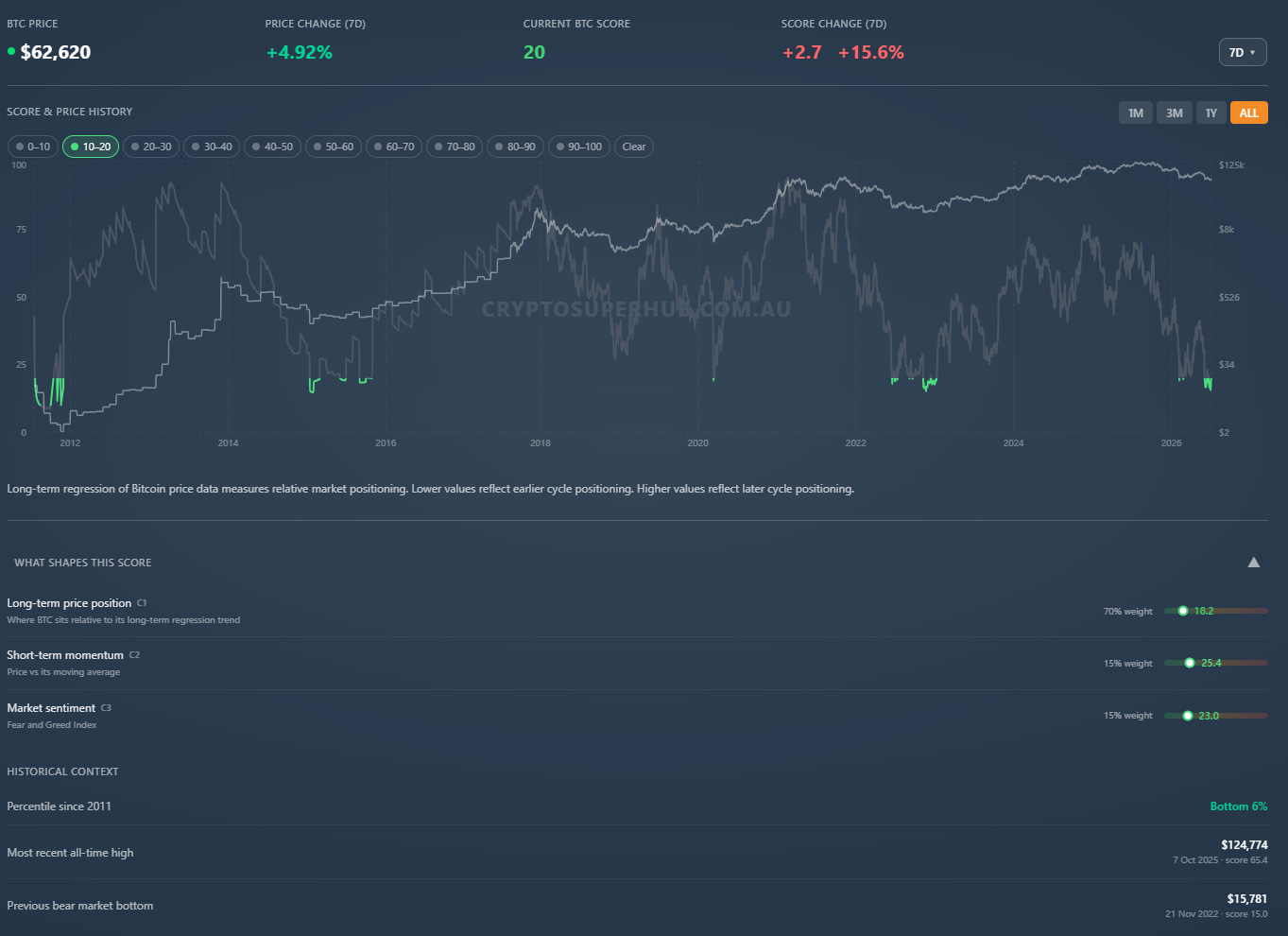
CSH Score: 20.0 (BTC ~US$63,100 as of Sunday)
The Score spent almost the entire week below 20 and touched 15.5 on Wednesday 1 July, its lowest reading since the November 2022 cycle bottom printed 15.0. Sunday’s 20.0 sits in the bottom 6% of every daily reading since 2011.
Under the hood: long-term price position reads 18.2, short-term momentum 25.4, and market sentiment 23.0. All three components are in the green zone at once, which is rare.
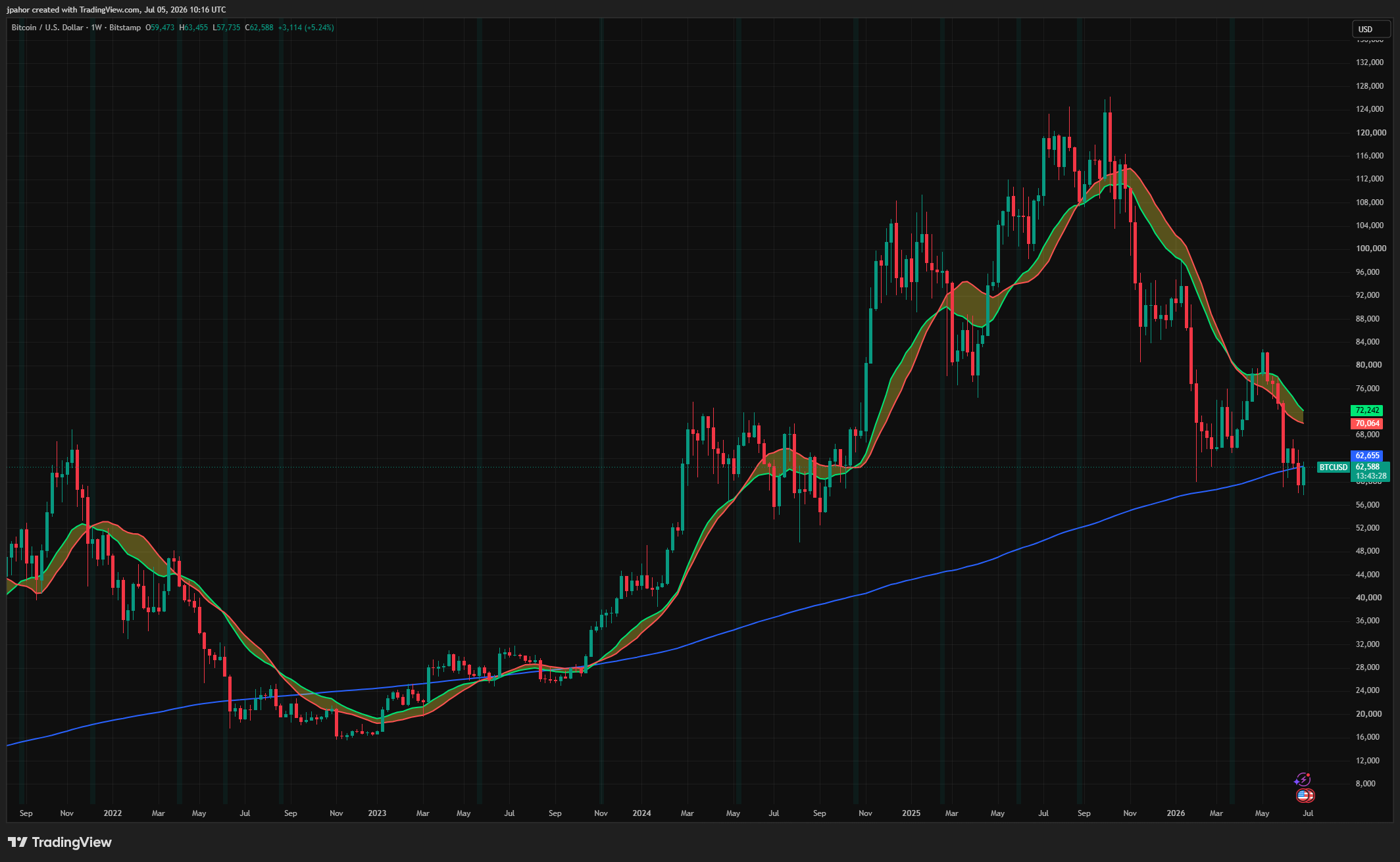
Price context matters here. BTC closed last week near $61,600, just under the 200-week moving average around $62,660, and spent this week grinding back up to that line. The last time price spent real time below the 200-week was 2022. Below it sits the 300-week near $55K.
Plain-English read: this is statistically cheap. It is not a guarantee of a bottom. The Score read 15.0 in November 2022 and that was the low, but it also read under 16 for most of late 2011 while price kept chopping for months. Cheap is a condition, not a timestamp. The system’s job is to size your buying to the condition, not to call the day.
The Rule That Isn’t Coming for Your Crypto
From 1 July, every Australian exchange is required by AUSTRAC to collect and share information about the sender and recipient when crypto moves between platforms. It’s called the travel rule, it’s part of the AML/CTF reforms passed in 2024, and it applies to every transfer with no minimum threshold. A $5 transfer triggers the same data collection as $50,000.
I’ve spent months on the inside preparing for this, and the last fortnight fielding the panic. Three myths worth killing:
Myth 1: the exchanges are the bad guys. Exchanges didn’t ask for this rule. They’re legally required to run it or they get shut down. I’ll say the quiet part: most people building Australian exchanges are freedom-leaning crypto natives who hate paperwork as much as you do. And without trusted on-ramps and off-ramps, this industry doesn’t exist at the scale it does today. Blame the right party.
Myth 2: withdrawals are getting blocked. The opposite, mostly. Transfers to your own self-custody wallet still work, and under AUSTRAC’s own guidance they’re exempt from the information-sharing requirement between institutions. What changes is a few extra fields at the point of sending: is this your wallet, another exchange, or a third party. Provide it once per counterparty and it’s saved. If you’ve ever sent an international bank transfer, you’ve done this before.
Myth 3: it’s a stealth tax. It isn’t. No new tax was created on July 1 for ordinary crypto holders. It’s data collection for anti-money-laundering purposes, the same framework banks have operated under for years. The tax changes are real but separate, and they’re in Quick Hits.
Here’s my honest position. I want less regulation, not more, and I want crypto to keep its core promise as peer-to-peer electronic cash. But I’ve also sat across from people who lost six and seven figures to scammers, and traceability genuinely helps recover stolen funds and shut those operations down. It’s a balancing act, and this rule lands closer to “annoying paperwork” than “confiscation.”
What you should actually do: nothing dramatic. Keep good records, expect a couple of extra fields when you withdraw, and if self-custody matters to you, it still works exactly as it should.
Want your risk sized to conditions rather than headlines? Create your free CSH account and set your plan in Plan Builder.
Jake’s Workbench
I bought this week. Small tier, midweek, with the Score at 15.5.
It felt bad, which is usually the sign it’s the right kind of buy. My plan has a tier for readings under 20 and the plan got the vote, not my gut. In 2021 my gut voted on everything and it cost me the entire bottom of the last cycle.
The bigger picture: I’m still sitting on a decent cash position, and the plan is to deploy it through CSH dynamic DCA between now and October. Not lump-summing, not waiting for a magic number. Sized buys, weighted by the Score, on a schedule. If we get one more leg down toward the 300-week, the tiers get bigger automatically. If we don’t, I’m already in.
That’s the whole point of building the system. The strategy was decided months ago on a calm day. This week just executed it.
Quick Hits
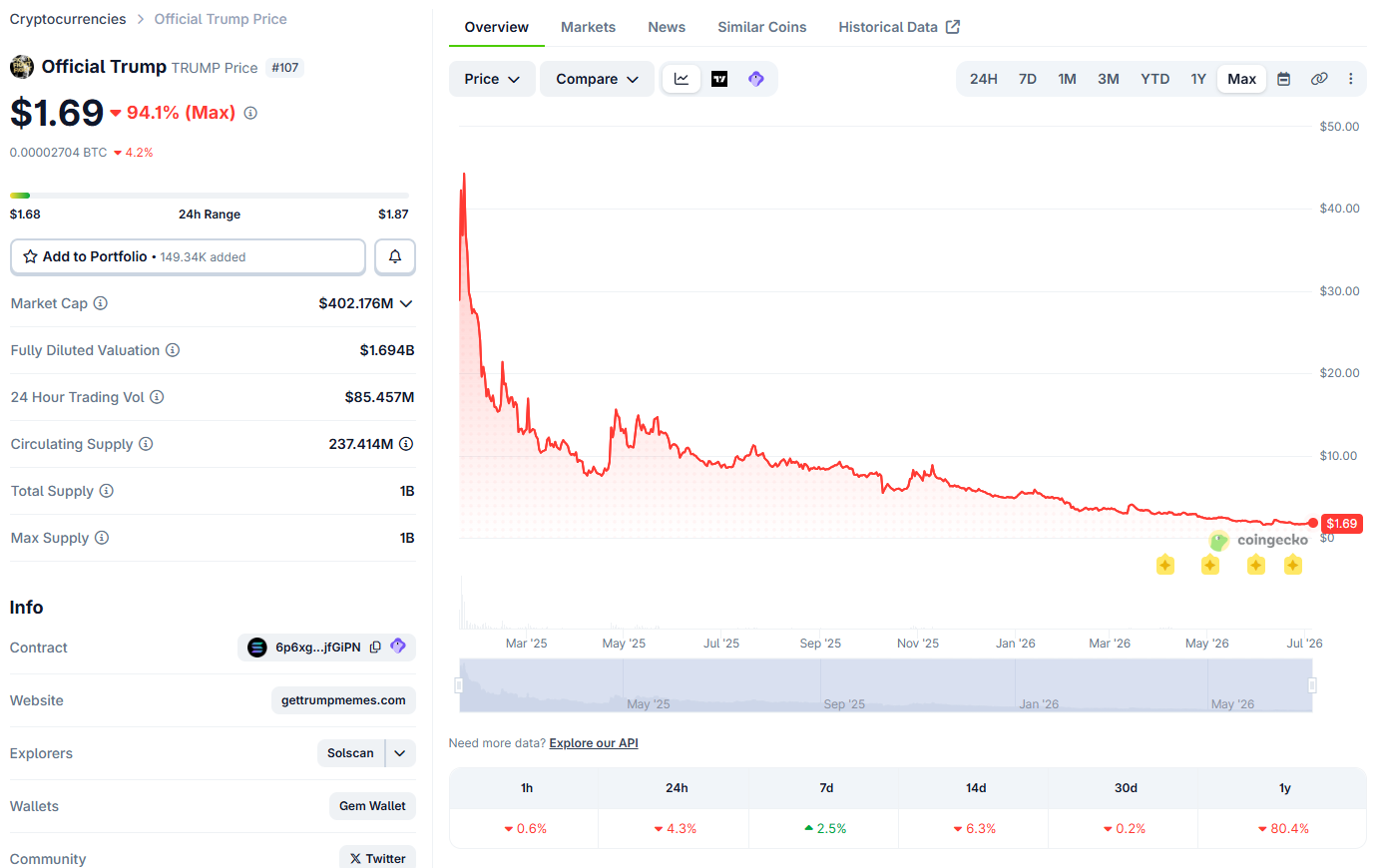
A $1.4 billion year. The US President’s financial disclosure, released Tuesday, showed roughly $1.4 billion in crypto-related income for 2025, including about $635 million in royalties tied to the $TRUMP token. That token peaked at $74.24 within a day of its January 2025 launch and now trades around $1.69, down 94%. So what: the people who launch these products get paid either way. Always check who profits from what you’re buying.
Division 296 is live. From 1 July, earnings attributable to super balances above $3 million cop an extra 15% tax. So what: most SMSFs are untouched, but if your balance trajectory could cross $3M this cycle, model it now, not later.
First weekly close below the 200-week MA since 2022. BTC closed last week near $61,600 against the ~$62,660 line. So what: reclaiming that level on a weekly close is the single cleanest signal that the worst is behind us. Until then, respect the downside.
The travel rule has no minimum threshold. Unlike most overseas versions, Australia’s rule applies to every transfer, any size, from dollar one. So what: don’t bother structuring small transfers; it changes nothing except your time.
The Week Ahead
The 200-week weekly close. The line sits near $62,660 and price is grinding right at it. Above it on a weekly close, the relief rally has legs. Below it, the 300-week near $55K stays the base-case magnet.
New financial year flows. July 1 unlocked a wave of SMSF establishments and contributions. I’ll be watching whether that structural bid shows up in the data while retail stays absent.
The Score under 16. Only four periods since 2011 have printed sub-16 readings: late 2011, January 2015, November 2022, and this week. In January 2015, BTC was $178 and sat at $430 a year later. In November 2022 it was $15,781 and above $35,000 a year later. Base rates, not prophecy. But I know which side of that history I want to be positioned on.
The Close
Everyone is kicking crypto right now. Engagement is at cycle lows, the grifters are cashing out, and the asset just closed below a level it hasn’t lived under since 2022. This is exactly what the best accumulation windows in fifteen years of data have looked like. Zoom out, trust your plan, and lock in.
Bull markets make you money. Bear markets make you bloody rich.
Create your free CSH account and let the Score size your next buy.
Talk next week, Jake