

In 2026, there will be generational investing opportunities.
But most people won’t execute.
Not because they aren’t smart.
Not because they don’t believe in crypto.
Not because they don’t have capital.
They won’t take advantage of them because they don’t have a system.
I’ll be honest with you.
I’ve been in crypto for over five years, and I’ve fucked up more times than I can count.
In fact, if I had done just one simple thing — consistently dollar-cost averaged into Bitcoin from day one — I’d almost certainly be sitting on far better returns today.
That realisation hurts.
But every mistake came with a lesson.
And every $1 lost has the potential to become a future $10 — if you actually learn from it.
This piece outlines the system I now use to prepare for what I believe could be generational opportunities heading in 2026.
My Investing Philosophy (Simple, Not Easy)
My investing philosophy is straightforward:
Accumulate more Bitcoin over time.
Before anyone jumps to conclusions — I’m not a Bitcoin maxi.
If an altcoin opportunity presents itself with a compelling risk-to-reward profile, I’ll rotate capital aggressively.
That said, this cycle has reinforced something important:
Bitcoin is still king.
If your investment horizon is 10+ years, ask yourself honestly — what crypto asset, aside from Bitcoin, has a high probability of still existing a decade from now?
This is also why I don’t measure my portfolio in fiat terms (USD or AUD).
Fiat currencies trend asymptotically towards zero over long timeframes.
I measure performance in Bitcoin.
I’m also not a day trader.
I don’t have 14 hours a day to stare at charts — and even if I did, I wouldn’t want to.
My edge is time.
Time in the market > timing the market
Crypto is volatile by nature.
The goal isn’t to avoid that volatility — it’s to use it.
Which brings us to systems.
Why DCA Works (And Why It Can Be Improved)
A simple DCA strategy works remarkably well for most people.
For example:
If you invested $50k into Bitcoin six years ago and added $1k per month thereafter, you’d be sitting on close to a $1 million portfolio today — roughly a 6x return.
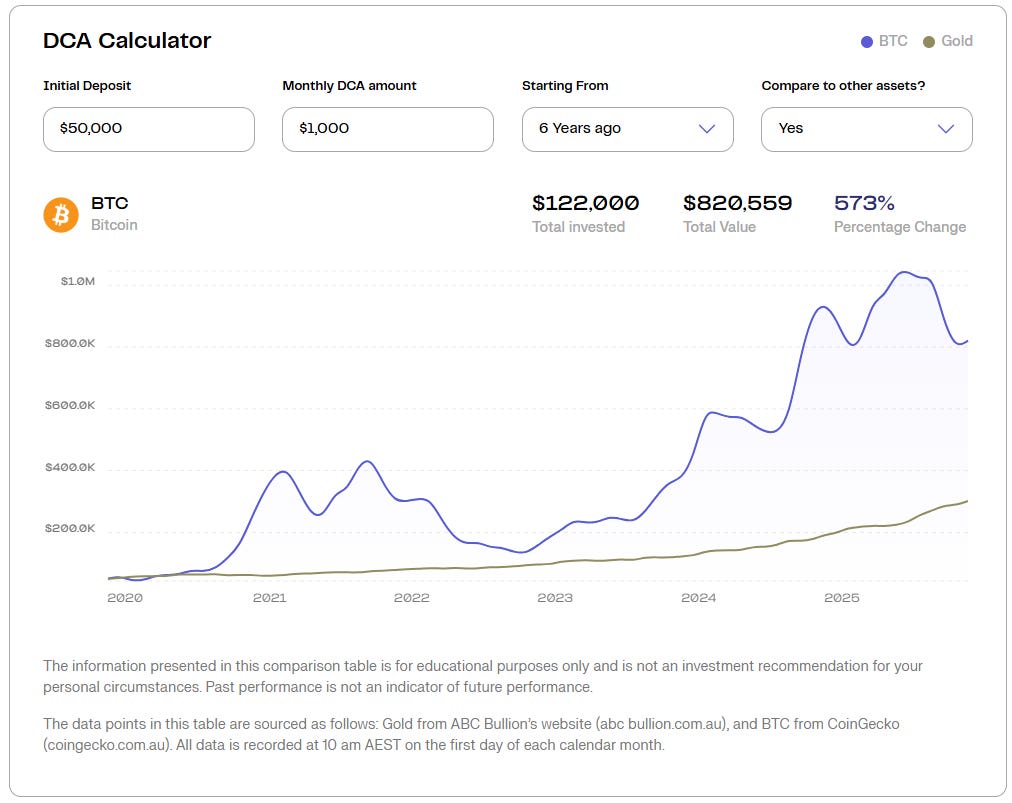
Historical example of Bitcoin DCA performance using a fixed monthly contribution. Source: Coinstash
That’s an excellent outcome.
But we also know Bitcoin is up more than 1,300% since January 2020.
And we know Bitcoin tends to follow relatively consistent four-year cycles, with clear bull and bear phases.
So the question becomes:
How do we improve on basic DCA without turning investing into a full-time job?
Introducing Dynamic DCA
The answer is combining traditional DCA with risk awareness.
DCA is powerful because it removes emotion and decision-making whilst letting compounding do the work.
But we can improve it by adjusting how aggressively we buy based on where we are in the cycle.
One of the most grounded analysts in crypto, in my opinion, is Benjamin Cowen (Into the Cryptoverse).
His Risk Metrics were a genuine lightbulb moment for me.
Here’s how he describes them:
The purpose of the Risk Metric is not to predict market tops or bottoms, but to identify regions that are historically attractive for buying or selling over longer timeframes. Low risk suggests favourable buying zones, while high risk suggests caution or profit-taking.
This is important.
It’s not about perfection.
It’s about consistency and discipline.
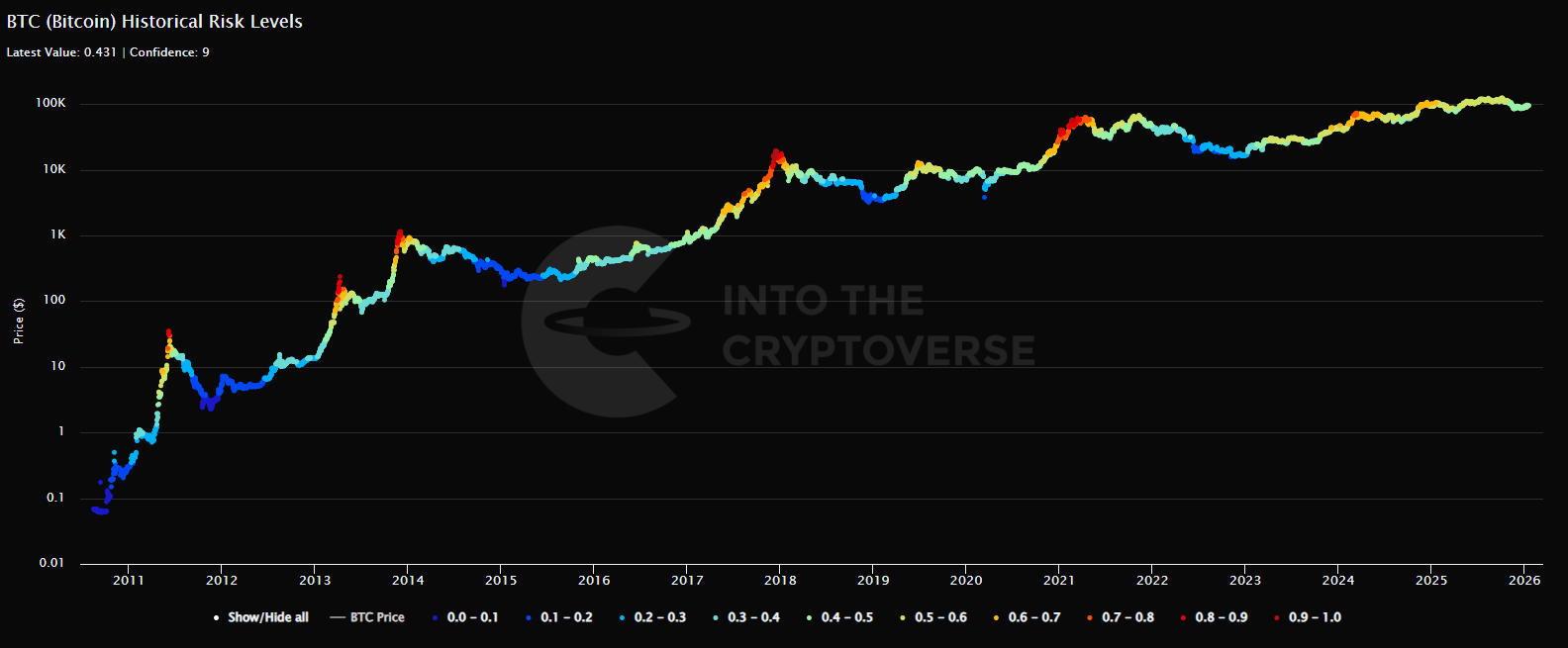
Historical Bitcoin price data overlaid with risk metric bands indicating relative long-term buying and selling regions.
Source: Into the Cryptoverse
The Dynamic DCA System
I built a simple spreadsheet that combines:
Traditional DCA
Risk-based multipliers
It serves two purposes:
Accumulate more aggressively when risk is low
Take profits systematically when risk is high
Let’s break this down.
Accumulation: Buying When Risk Is Low
On the accumulation side, the process is simple.
You:
Input the current Bitcoin risk level
Select a strategy (Conservative, Balanced, Aggressive)
Enter your available capital and accumulation timeframe
The spreadsheet then calculates a dynamic monthly DCA amount.
Some examples:
BTC risk = 0.43 (current value)
→ Monthly buy: $3,954 AUDBTC risk falls to 0.30
→ Monthly buy increases to: $5,108 AUDHistorically deep value (~0.15 risk)
→ Monthly buy increases to: $7,429 AUD
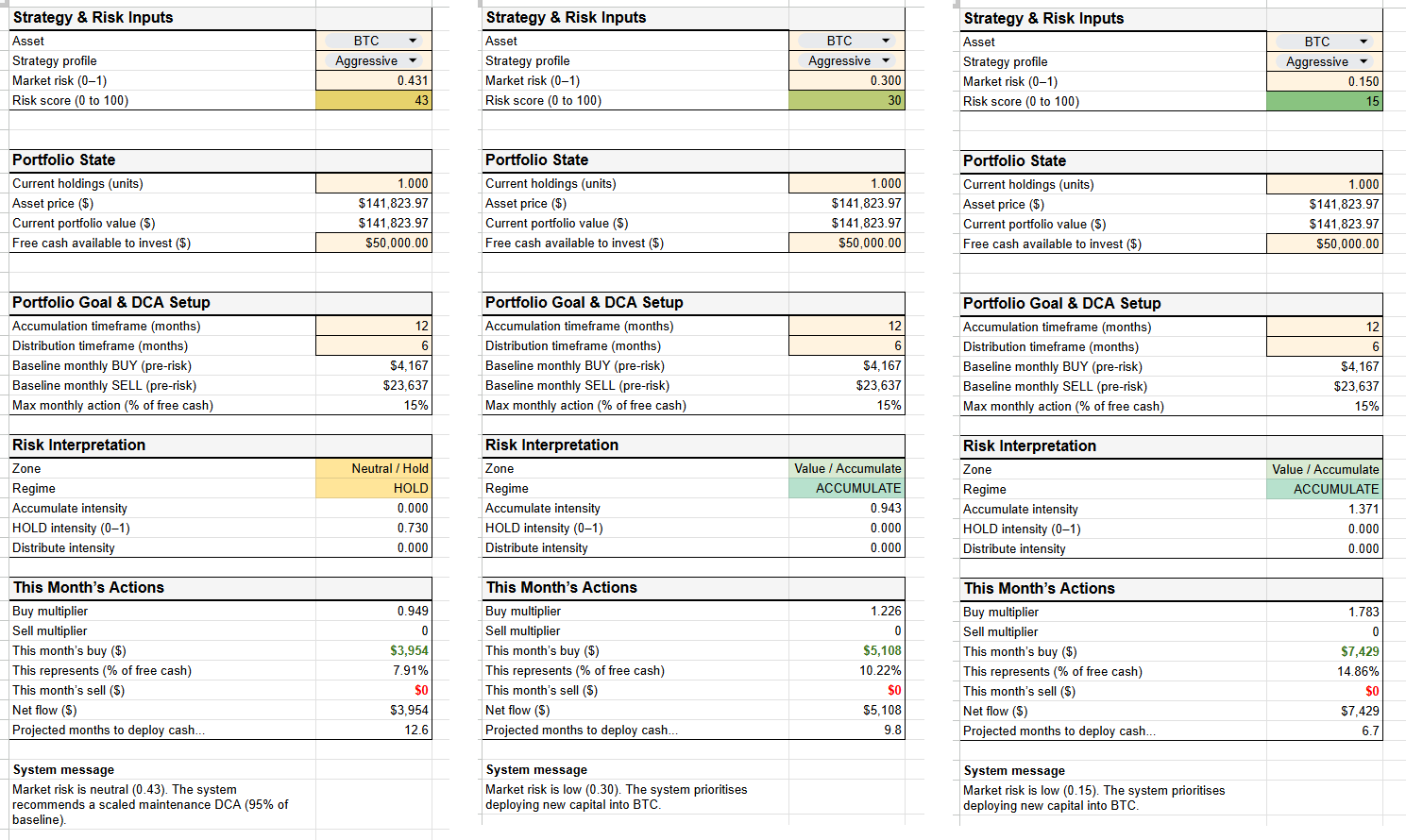
Dynamic DCA in action across different BTC risk regimes — neutral, accumulation, and deep value.
This isn’t fully “set and forget”.
You need to update the risk input periodically — weekly, fortnightly, or monthly.
But that small effort may be the difference between:
A modest outcome (2-3x)
And materially increasing your Bitcoin stack next cycle (5-6x)
Taking Profits: Removing Emotion at the Top
Buying is easy.
Selling is where most people fail.
When markets are euphoric, logic disappears.
This is where a system matters most.
Using the same spreadsheet, you can pre-plan exits before emotions kick in.
For example:
BTC risk reaches 0.65
→ Begin skimming profits: $8,270 AUD sellBTC risk reaches 0.9 (historically dangerous territory)
→ Larger sell: $21,265 AUD
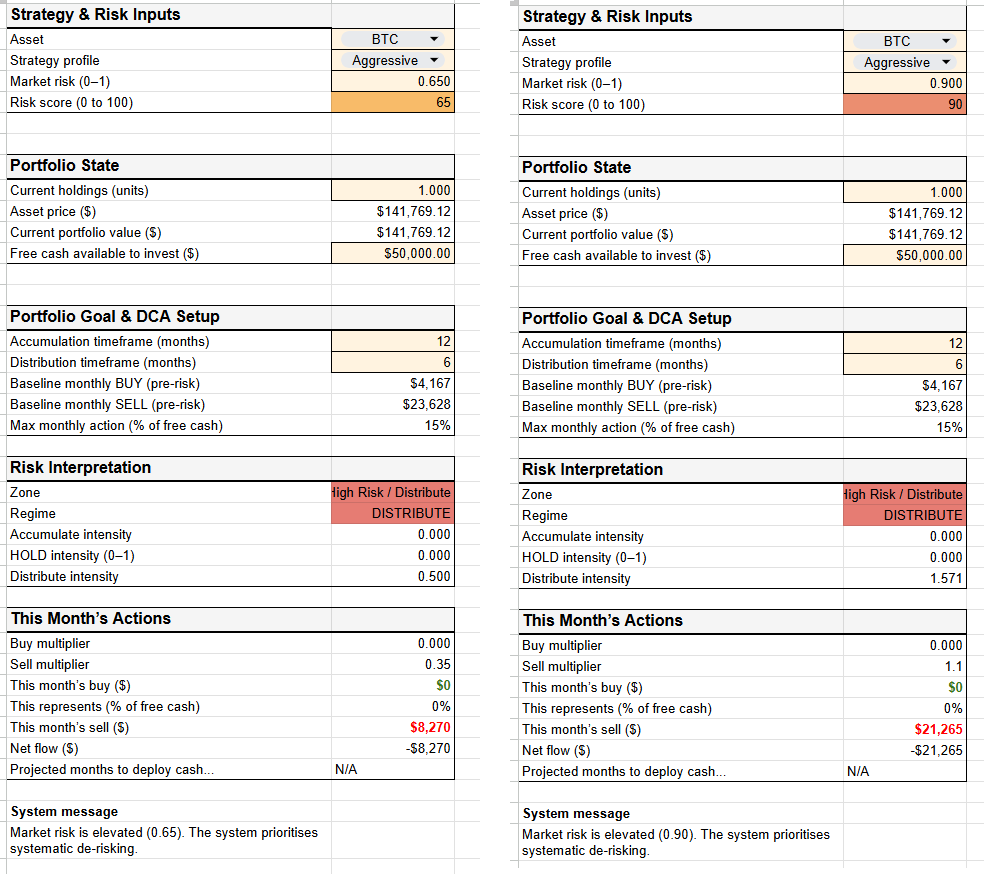
Dynamic distribution during elevated risk regimes — systematic de-risking as market euphoria increases.
Another approach is to pre-define exit bands based on:
Risk levels
Percentage of portfolio sold at each level
You can keep it simple or make it more aggressive.
The important thing is this:
The decision is made in advance.
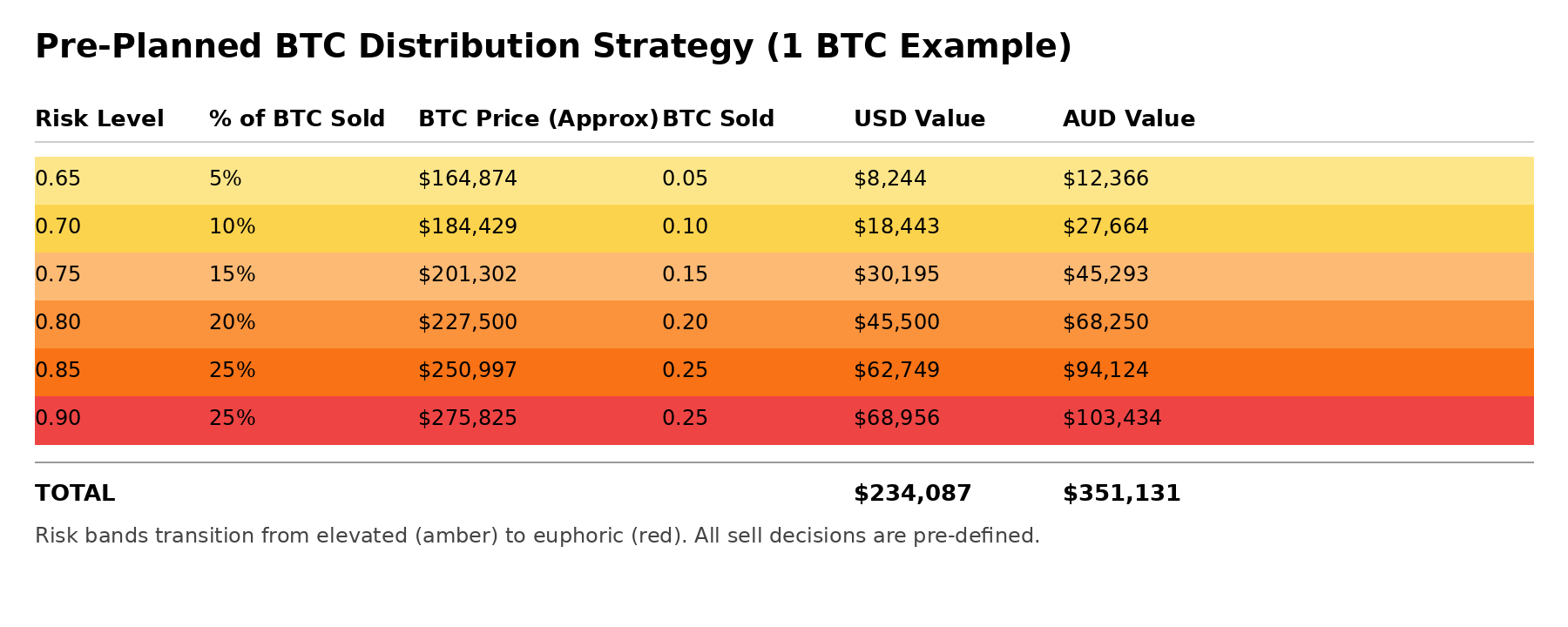
Example of a risk-based Bitcoin distribution framework, where sell decisions are defined in advance across increasing risk bands.
Final Thoughts
This system isn’t perfect.
Could you outperform it by trading aggressively? Possibly.
But I know myself well enough to know I need a framework to fall back on — especially when emotions are high.
“You do not rise to the level of your goals. You fall to the level of your systems.”
— James Clear
A system gives you:
Consistency
A baseline to improve from
A way to remove emotion from decisions
This is not financial advice.
What works for me may not work for you.
But the best investors I’ve met all share two traits:
They have a system
They are patient
The best investors are almost always boring.
They wait.
They observe.
And when opportunity appears, they execute without hesitation.
If you’d like to discuss this further, feel free to reply or DM me.
The spreadsheets I’m developing aren’t public yet, but if you’d like to beta test them, let me know and I can give you access.
— Jake
the big question is: where do you get the risk score from? is there a source for that or can you calculate it from "fear an greed index" or "BTC dominance" etc.? would be nice to be part of beta testing your spreadsheet... thanx for your idea and contribution!
This felt less like an article and more like an operating manual.
The focus on execution over narratives is exactly the layer most people still miss.