


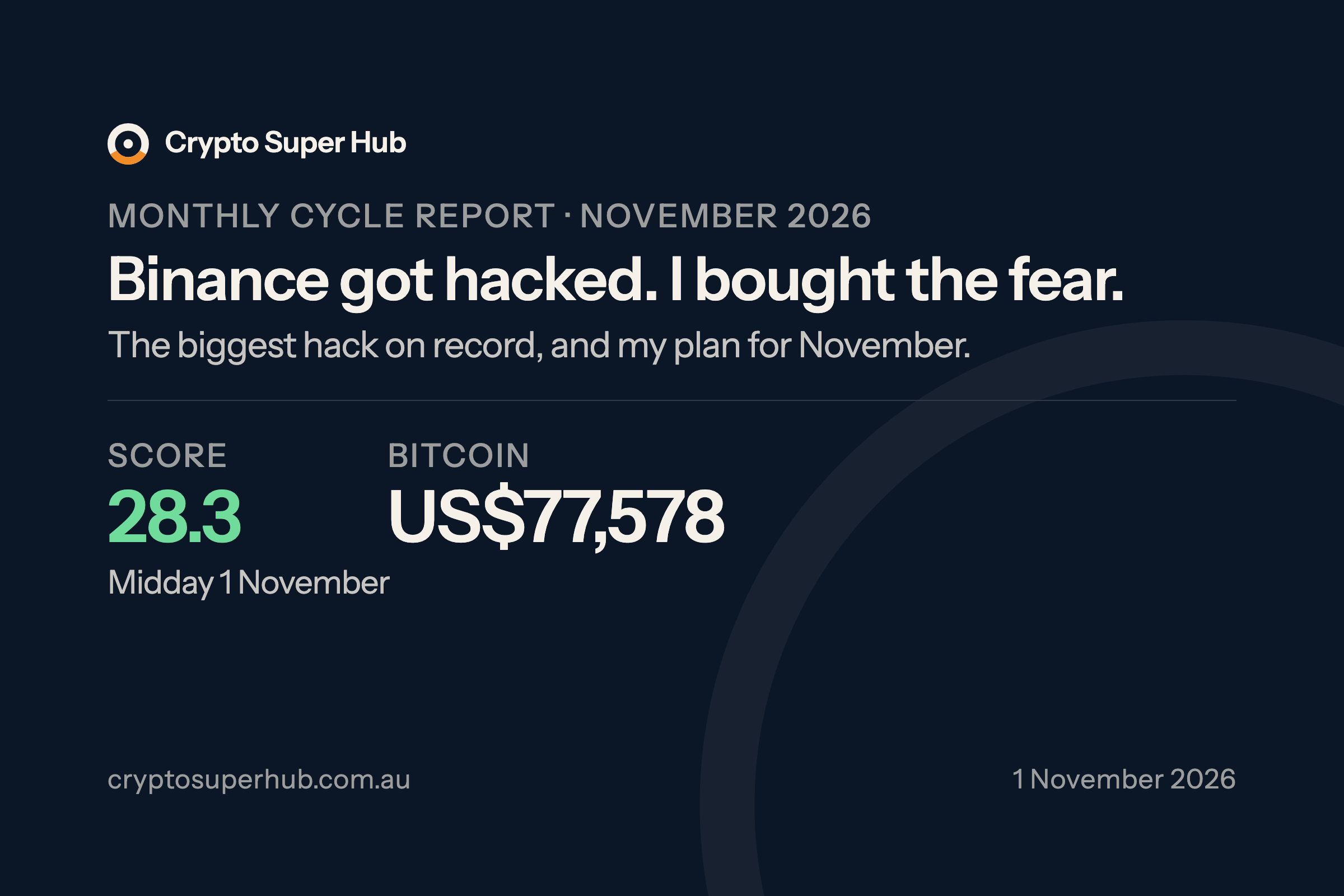
When I woke up on Friday, the first thing I saw in my DMs was: BINANCE HAS BEEN HACKED.
It was the biggest crypto hack on record, about US$6.3 billion. My first thought was that we were due a massive correction, maybe 20% or more. I was ready for carnage.
It never came. Bitcoin fell about 5%, and there was no real contagion.
That capped off a rough month. In #37 I said forget Uptober, we were in for Choptober. We got Downtober: Bitcoin fell 7.3% in October, and the CSH Score dropped under 30. I’m still buying.
Scoring October’s three tests
No weekly close under the 50-week moving average before the US midterms. So far, so good. Every weekly close in October stayed above it. The last one before the midterms is tomorrow morning, and Bitcoin is 2.4% above it today.
A weekly close above the January high of US$97,939. No. October’s best weekly close was US$86,510, on 4 October.
More money into US spot Bitcoin ETFs than out in October. No. About US$515 million more went out than came in (SoSoValue).
October in numbers
Bitcoin closed October at US$77,430, down 7.3% (Bitstamp). In Australian dollars, about A$110,200, down 8.1%.
Its low was US$76,173 on 30 October, the day after the hack.
It closed two weeks under the May high, about US$82,800.
US spot Bitcoin ETFs: about US$515 million out, after US$2.65 billion in during September.
The CSH Score went from 36.4 to 28.3, its lowest since August.
What the reading changes: my plan buys every week while the CSH Score is under 45, more the lower it goes. In #38 I said my spare cash stays parked unless the Score drops under 30. On the day of the hack it hit about 30, so I topped up with an extra buy. In the app, a top-up like that sits next to your plan: one click to log it, or upload your exchange’s CSV.
What happened with Binance
On 29 October, North Korea’s TraderTraitor group took about US$6.3 billion from Binance, according to Binance, TRM Labs, Chainalysis and Elliptic. That’s about four times the previous record, Bybit’s US$1.5 billion in February 2025. Elliptic calls it almost certainly the largest single theft of any kind in history.
Within 40 minutes, Tether and Circle had frozen about US$1.8 billion of the stolen stablecoins. The hacker then used US$60 million of stolen USDT on Aave to borrow about 19,760 ETH, swapping coins that can be frozen for one that can’t.
Credit to Binance: I think it handled it very well. Within hours it said no customer would lose money, and it set aside more than US$6.34 billion of its own money to cover the loss. It says withdrawals reopen today.
This wasn’t FTX. In 2022 that exchange lost its customers’ money, wasn’t solvent, had a run, and dragged others down with it.
The scariest part for me is custody. I’ve never felt so unsure about the best way to hold my crypto. Hold it yourself? Coldcard and Ledger users have lost about US$200 million since July, through a firmware bug and tampered devices sold by a reseller. Hold it on the world’s biggest exchange? It just got hacked. 2026 is already the worst year for crypto hacks on record, at US$8.7 billion, most of it this one (TRM Labs). There’s no right answer. I think AI will bring the next big wave of custody tools, and I’m looking hard at multi-signature setups that are easy to use. I’m rethinking how I store my own crypto.
Crypto’s worst days, and what came next
I looked at what Bitcoin did after crypto’s biggest disasters, and where the CSH Score was when each one hit (our score history):
Mt Gox, 2014: Score 76.8. A year later, Bitcoin was 71% lower.
Terra, 2022: Score 51.3. A year later, 19% lower.
Bybit, 2025: Score 73.3. A year later, 31% lower.
FTX, 2022: Score 16.5. A year later, 72% higher.
Binance, now: Score 31.4.
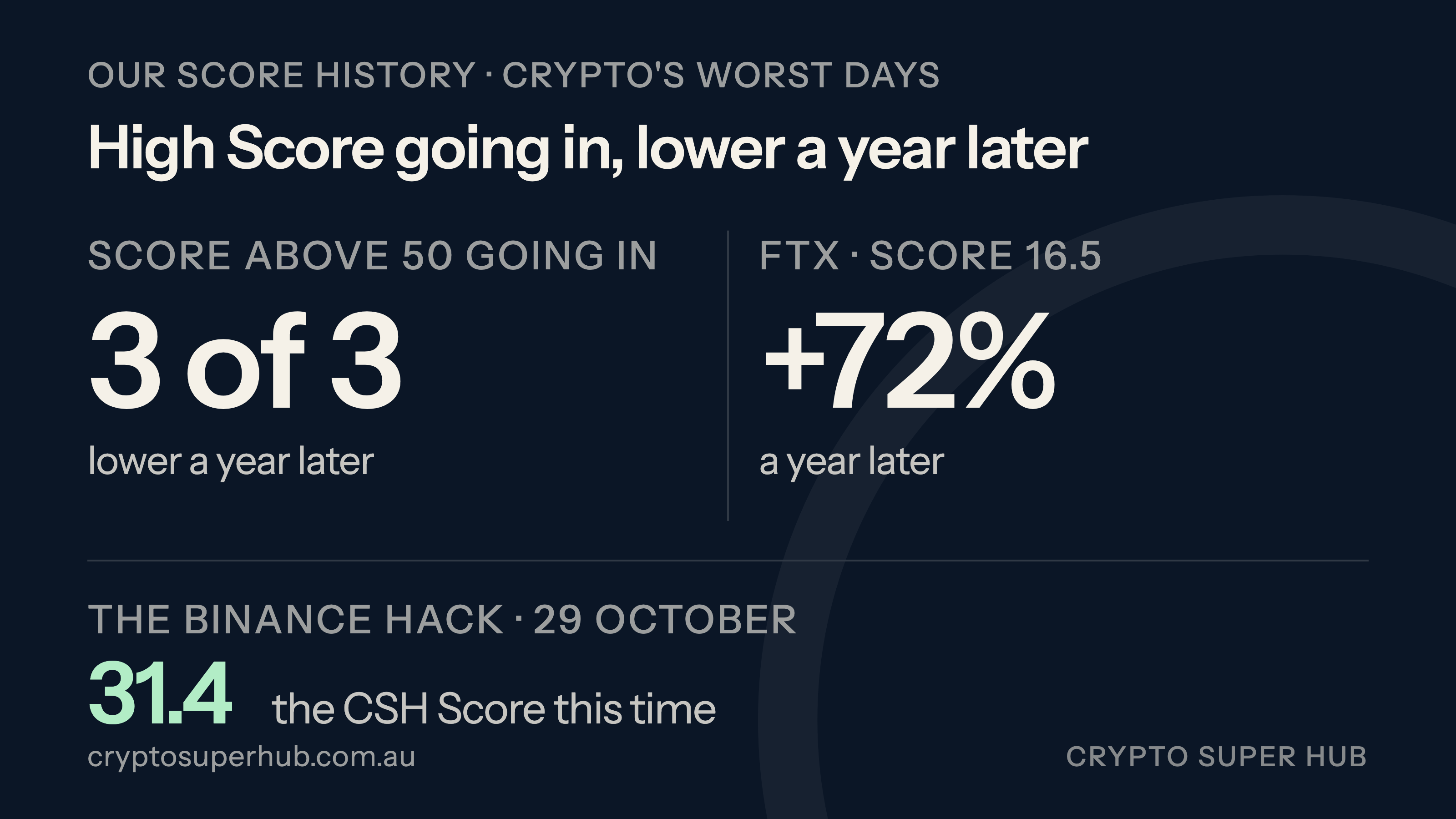
The three with a high Score were all lower a year later. The one with a low Score, FTX, was 72% higher. This time the Score was 31. Five events is a small sample, and it’s hindsight, not a promise.
My take: Bitcoin has stayed this resilient through the biggest hack in crypto history. That has to be very bullish long term.
Has the 50-week average been tested this early before?
The 50-week moving average is Bitcoin’s average weekly close over the last year. When Bitcoin gets back above it after months below, it has usually marked the start of a bull market.
This time Bitcoin got back above it on 20 September. Six weeks later, on 30 October, it closed within 1.5% of it. That’s early, so I checked whether it’s happened before.
In 2015, 2019 and 2023, Bitcoin didn’t come back near the average for months. Twice it came straight back:
2020: it dipped under for one week, then held. Six months later Bitcoin was up 75%.
2022: it failed. Six months later Bitcoin was down 58%.
The difference was the CSH Score when Bitcoin first got back above the average: 27.9 in 2020, 64.4 in 2022. This time it was 32.2.
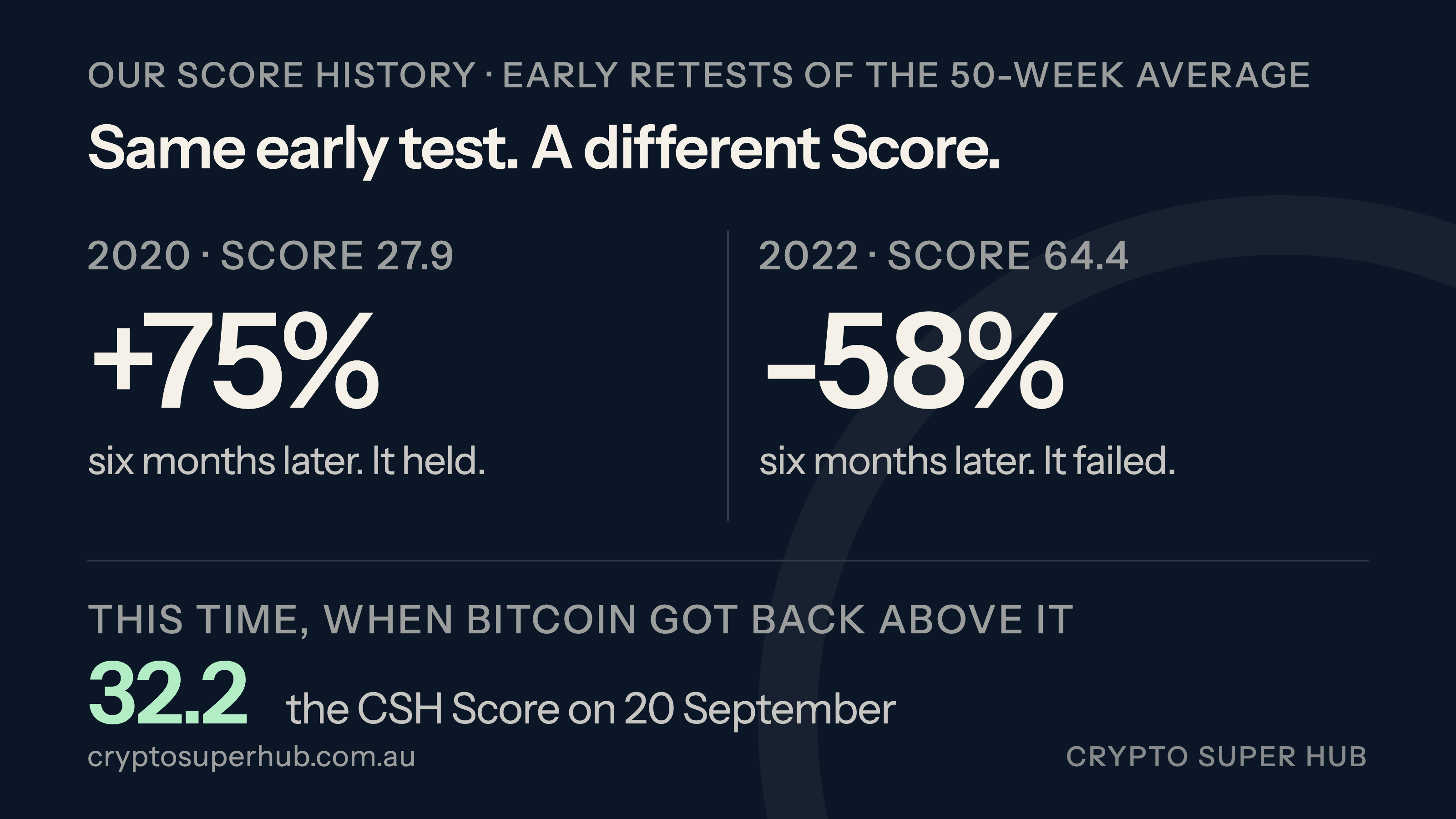
Same caveats: a small sample, and today’s model looking back.
Where we are in the cycle
The level. The 50-week moving average, about US$75,700. On 30 October Bitcoin dipped to within 1% of it, and into the bull market support band, two shorter averages between about US$73,000 and US$76,700 (TradingView, Bitstamp, 1 November).
Timing. Every past bear market bottomed 363 to 410 days after the top. For this cycle that window ends on 20 November. If the July low of US$57,735 holds, this bear ended early. Even after October, Bitcoin is still 34% above that low.
Rates. In 2018 and 2022, Bitcoin’s worst stretch came after the US 10-year yield peaked in October or November. This October it hit 5.31% on the 5th, then closed the month at 4.94% (US Treasury).
What else moved in October
ETF money left after the hack: US$643 million out of US spot Bitcoin ETFs on the day after (SoSoValue).
The Fed held rates, but two of its members voted for another hike (28 October).
Inflation here rose to 4.3% in the year to September, from 4.0% (ABS). The RBA decides on Tuesday, with the cash rate at 4.60%.
November: three paths, one plan
The CSH Score rates where Bitcoin’s price sits in its own history, from 0 to 100. My plan buys anywhere under 45, more the lower it goes, and takes profit from 75. On 31 October a Score of 45 was about US$93,100, and 75 was about US$126,200.
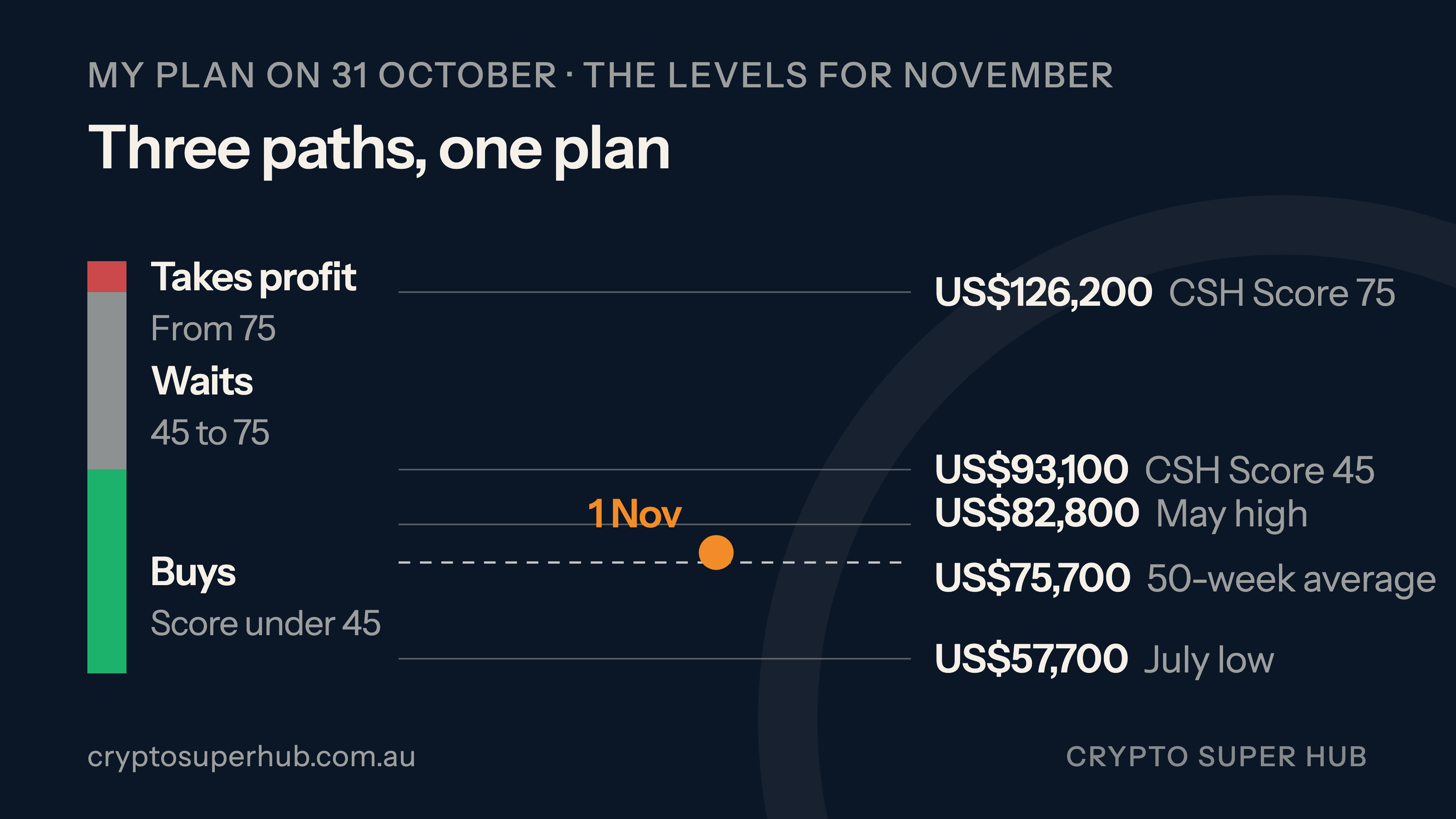
Path one: Bitcoin gets back above the May high. Weekly closes above about US$82,800. The bull market is back on track. My plan keeps buying, a little less each time, until the Score reaches 45.
Path two: Bitcoin holds the 50-week. Weekly closes stay above about US$75,700. I think the bull market is still intact. My plan buys more as the Score falls.
Path three: several weekly closes under the 50-week. That could be short-term bearish, and we might see a 2019 to 2020 style final drop before the real bull market starts. My plan doesn’t change. It keeps buying.
I’m still optimistic. Bitcoin has held up through a lot of bad news, and to me that’s extremely bullish. What you do is your call. Let’s watch this weekly close.
What I’m watching
Mon 2 Nov, 10am: the weekly close against the 50-week moving average. It’s also the tax return deadline if you lodge your own.
Tue 3 Nov, 1:30pm: the RBA’s decision.
By Wed 4 Nov, 10am: Binance’s proof that customer assets are fully backed.
Wed 4 Nov: US midterm results. They shape the Senate that would take up the crypto market structure bill next year, after it fell short of the 60 votes it needed in September.
Fri 6 Nov, 11:30pm: the US jobs report, the main US number before the Fed meets on 8 to 9 December.
Tue 10 Nov, 11:30pm: US inflation for October.
Fri 20 Nov: the end of the window where every past cycle low landed.
(All times are Brisbane time.)
Three tests for December
I’ll score these next month, whichever way they land.
No weekly close under the 50-week moving average in November.
A weekly close back above the May high, about US$82,800.
More money into US spot Bitcoin ETFs than out in November.
Hit reply with one word: does Bitcoin finish November above or below US$80,000? I’ll share the count next month.
The Close
Days like Friday are why Tom and I built Crypto Super Hub. When the news hits, your plan has already decided what you do.
You get the CSH Score, updated every hour, and a plan builder that turns it into orders at real prices. Every buy and sell you log is stamped with the Score at the time, so you can see whether you bought low and sold high.
It’s coming to your phone too. Our iPhone and Android apps launch together once Apple approves the iPhone one.
If you’re new, it’s free for two weeks, and nothing is charged until day 15. The first 100 members lock in A$19 a month for life. After that it’s A$29.
Crypto Super Hub is general information and education only. Nothing here is financial advice, and it doesn’t take your objectives, financial situation or needs into account. Crypto is volatile and you can lose money. Past performance doesn’t guarantee future results. Do your own research and consider speaking with a licensed financial adviser before making investment decisions. We hold Bitcoin ourselves, so assume we’re biased.