



Three weeks ago I sent you an issue called “Is the Bitcoin bear over? Probably.” This week Bitcoin dropped as low as US$80,300 before bouncing back to around US$83,000, right on the high it set in May. Bulls and bears are fighting over that level, and it’s the one I’m watching most closely.
The short version: I still think the bear market ended in July. If I’m right, the May high should hold on a weekly close. If it doesn’t, that’s the first warning. A weekly close under the 50-week moving average, about US$77,100, would change my mind. My plan buys while the CSH Score is under 45, and buys more the further Bitcoin falls. Whichever way this goes, I have a plan for it, and I think you should too.
This is the first of a new monthly issue. Each month I’ll cover what happened, why, the paths from here and what my plan does on each. Then I’ll score my own calls the month after, whichever way they land.
September in numbers
Bitcoin closed September at US$83,563, up 6.4% and its best monthly close of 2026 (Bitstamp).
In Australian dollars it was up 9.3%, because the Aussie dollar fell against the US dollar.
On 20 September it closed a week above its 50-week moving average for the first time in 44 weeks.
The next day it broke the May high of US$82,833 and got to US$87,374.
US spot Bitcoin ETFs took in US$2.65 billion, after US$3.52 billion in August (SoSoValue).
The CSH Score finished August at 31.0 and September at 36.4.
What the reading changes: my buy plan buys anywhere under a CSH Score of 45, and the Score hasn’t been above 45 since January. At midday on Sunday the CSH Score was 35.0, with Bitcoin around US$82,900 (about A$119,000), so the plan is still buying. This week it bought a smaller amount with the Score in the 35 to 40 band. Its bigger buys sit in the 30 to 35 band, about US$79,100 to US$83,300 on Sunday, and I’m hoping for a pullback into that band this week. It would take a rise to about US$92,300 for the Score to reach 45 and the buying to stop.
What happened
On paper, September should have been a bad month for Bitcoin.
Oil jumped back above US$100 a barrel after fighting flared up again around the Strait of Hormuz at the start of September. Higher oil means higher inflation, and central banks kept raising rates to fight it. The US Federal Reserve hiked on 16 September, its first rise since 2023. Five other central banks raised in September too, including the RBA on the 29th, which took our cash rate to 4.60%. The US 10-year bond yield finished the month at 5.29%, its highest since 2002.
That matters because when a US government bond pays you over 5%, an asset that pays nothing, like Bitcoin, is a harder sell.
Bitcoin went up anyway. The one wobble came on 15 September, when a US Senate vote on the CLARITY Act, the big crypto market bill, failed by one vote. Bitcoin dipped just under US$75,000, and about US$571 million of bets made with borrowed money were wiped out (CoinGlass). Three days later it was back above US$80,000.
On the 20th it closed a week above its 50-week moving average. That’s Bitcoin’s average weekly closing price over roughly the last year. Weekly closes back above it have confirmed every Bitcoin bull market since 2015, usually a few months after the bottom. It has given false signals too, most famously in March 2022.
On the 21st it broke the May high, and ETF money followed: US$3.1 billion over the next nine trading days, including US$999 million on 21 September alone, the biggest day since October 2025 (SoSoValue, Farside).
I’ll be honest, I didn’t see it coming. A month ago I was expecting a downturn into Q4 and a few more chances to buy lower. I got complacent, and I wasn’t fully deployed. There’s nothing worse than watching Bitcoin rip while you’ve still got cash on the sidelines.
It wasn’t the first time this year either. In June and July, with Bitcoin between about US$58,000 and US$74,000, my plan said buy and my market bias said wait for lower. If I’d just followed the plan, I’d probably be close to fully deployed at much lower prices. Keep it simple, stupid, and stop trying to get too cute.
So I stopped fighting the market. At the end of September I raised the top of my buy range from 35 to 45, so my plan keeps buying at the start of a bull market instead of waiting for a dip that might never come. Now I’m sticking to it.
Why I think it happened
The bear market was short and shallow. For me, the euphoria this cycle peaked in January 2025, when the US president launched his own memecoin. By the October top it had mostly faded, and there was no FTX-style collapse to force one last crash. So the fall was smaller. If the 1 July low holds, this bear lasted 268 days and Bitcoin fell 54%. The three before it lasted 363 to 410 days and fell 77% to 87%.
ETF buyers came back. More than US$1 billion went into US spot Bitcoin ETFs in both August and September, straight after US$4.5 billion left in June. They kept buying through a month of rate hikes.
The trend reversed. In a downtrend, each high is lower than the last one and so is each low. Bitcoin made a higher low on 3 August, around US$62,200, then a higher high in September by breaking the May high. That’s what a trend reversal looks like. A smaller attempt failed between February and May. This one got past May’s top.
Why it’s slipped in October. The rally got crowded. By late September, people who’d bought in the previous five months were sitting on 33% unrealised profit, the most since December 2024 (CryptoQuant). When that many people are in profit, it doesn’t take much bad news for some of them to sell. October brought some: bond yields kept climbing, the Fed’s September minutes left the door open to another hike, and about US$390 million left the US spot ETFs in the first seven trading days (Farside, to 9 October). On 8 October alone, more than US$1 billion of bets on a rise made with borrowed money were wiped out (CoinGlass).
What our score history says
I went through every time since 2012 that Bitcoin has closed a week back above its 50-week moving average, and checked where the CSH Score was when it happened. It’s happened 11 times before this one, and the results split cleanly.
When the CSH Score was under 31, Bitcoin was higher a year later every time, 8 out of 8, by at least 55%.
When it was above 60, Bitcoin was lower a year later every time, 3 out of 3, by at least 39%. That includes March 2022, the false signal everyone remembers.
None came in between.
On 20 September the CSH Score was 32.2.
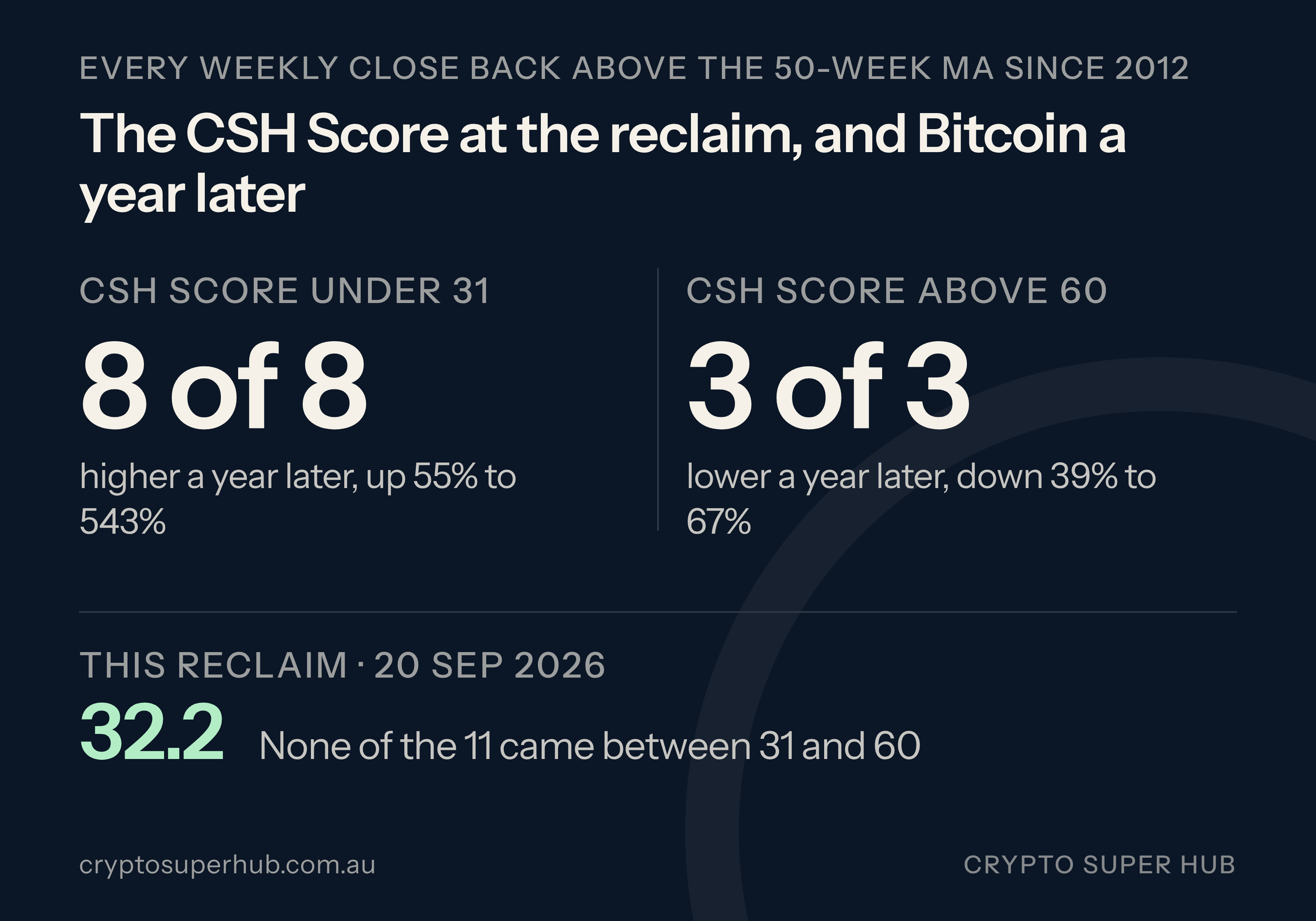
In plain English: the reclaims that worked came when Bitcoin was still low in its own history, after a long fall. The ones that failed came when it was already high. This one came low.
Two honest limits. Eleven is a small sample. And every reading in the Score’s history has been worked out after the fact with today’s model, so this is a look back with hindsight, not a promise about the next twelve months.
Where we are in the cycle
There are three common ways to time the end of a Bitcoin bear market.
Timing. Every past bear market bottomed 363 to 410 days after the top. This cycle, that window runs from 4 October to 20 November. If the July low holds, this bear ended about three months early. On 11 October Bitcoin was 44% above that low.
Seasonality. In US midterm election years, August and September have usually been weak. This year they were up 25% and 6.4%. The fourth quarter is the part still open. In 2018 and 2022, Bitcoin’s worst stretch came after the US 10-year yield peaked in October and November. That’s the best argument the bear case has left.
Valuation. Past bear markets bottomed below realised price, roughly the average price the whole market paid for its coins. That’s about US$53,700 (Newhedge, 6 October). This time Bitcoin never went below it.
Q4: three paths, one plan
The CSH Score rates where Bitcoin’s price sits in its own history, from 0 to 100. I run two plans on it. One buys anywhere under 45, with bigger orders the lower the Score goes. The other takes profit from 75. Between 45 and 75, neither plan does anything. On 11 October a Score of 45 was about US$92,300 and 75 was about US$125,600.

Path one: the May high holds and the rally keeps going. Weekly closes stay above US$82,800 and Bitcoin gets back above the September high. Once it’s past about US$92,000, the CSH Score goes over 45 and my buy plan stops. Taking profit doesn’t start until 75, which on 11 October was close to the 2025 all-time high. In the last three cycles, the Score took 20 to 25 months after the 50-week reclaim to get to 75. So on this path my plan mostly waits.
Path two: a pullback to the 50-week moving average, and it holds. The next level down is the 50-week moving average, about US$77,100 (Bitstamp, 11 October). It’s early in a bull market to be testing it, but it has been strong support in past bull markets. In 2015 to 2017 and 2023 to 2025, Bitcoin never had a weekly close below it once it had got back above it. In 2019 to 2021 it slipped under a few times, including during the COVID crash. On this path my plan keeps buying, and the orders get bigger as the CSH Score drops. Its larger buys start in the 30 to 35 band, about US$79,100 to US$83,300 on 11 October, and get bigger below that.
Path three: I’m wrong and the bear isn’t over. The warning sign is a weekly close under the May high. The real signal is a weekly close under the 50-week moving average. The case for this path is rates: they’re still rising, and the US 10-year hasn’t clearly peaked. A new low means Bitcoin falling under about US$57,700, the July low. On 11 October that was about where the CSH Score hits zero (about US$58,100), so that’s where my plan’s orders would be biggest.
If you’re sitting on cash waiting for a dip, I know the feeling. My plan doesn’t wait. It buys now because the Score is under 45, and buys more if the dip comes. What you do is your call. I’d rather make that decision now than halfway through a 20% drop.
What I’m watching
Mon 12 Oct, 10am AEST: the weekly close. Above US$82,800, the May high holds.
Wed 14 Oct, 10:30pm AEST: US inflation (CPI) for September. A hot number puts another Fed hike back on the table.
Wed 28 Oct, 10:30am AEST: Australian inflation for September, the main input for the RBA’s decision on 3 November.
Thu 29 Oct, 4am AEST: US Fed rate decision. Markets give a hike roughly a one-in-five chance (Investing.com Fed Rate Monitor, 10 October).
Sat 31 Oct: the Mt Gox repayment deadline, extended by a year last October. It’s also the tax return deadline if you lodge your own, which rolls to Monday 2 November because the 31st is a Saturday.
Tue 3 Nov: US midterm elections, and the RBA’s decision the same day.
Fri 20 Nov: the end of the window where every past cycle low landed. If July holds, this bear finished outside it, the first one to do that.
Three tests for November
I’ll score these in next month’s issue, whichever way they land.
No weekly close under the 50-week moving average before the US midterms on 3 November.
A weekly close above the January high of US$97,939.
US spot Bitcoin ETFs finish October with more money in than out.
Which path do you think we’re on? Hit reply with 1, 2 or 3. I’ll share how you voted in November’s issue.
The Close
Tom and I built the CSH Score and the plan builder so the decision gets made before the market moves, not in the middle of it.
You get the Score as it moves, updated every hour, a plan builder that turns it into orders at real prices, and a record of every buy and sell you make, stamped with the CSH Score at the hour you made it, so you can see whether you bought low and sold high.
If you’re new, it’s two weeks free, and nothing is charged until day 15. If you joined before the Score upgrade earlier this month, your trial runs to Saturday 31 October. The first 100 members lock in A$19 a month for as long as they stay. After that it’s A$29.
Crypto Super Hub is general information and education only. Nothing here is financial advice, and it doesn’t take your objectives, financial situation or needs into account. Crypto is volatile and you can lose money. Past performance doesn’t guarantee future results. Do your own research and consider speaking with a licensed financial adviser before making investment decisions. We hold Bitcoin ourselves, so assume we’re biased.