

Crypto Super Hub — Weekly Market Intelligence | March 29, 2026
Ten weeks ago I shared a system for navigating Bitcoin cycles.
A spreadsheet. Risk-based DCA multipliers. Pre-planned exits. That piece got more saves, more forwards, and more replies than anything I’ve written since.
But a spreadsheet has limits. You have to update it manually. The data goes stale. It works, but it’s clunky.
So instead of leaving it there, Tom and I built the whole thing into a live app. A proper risk score. A Plan Builder that calculates your DCA entries. Exit targets you set before emotions kick in.
Crypto Super Hub launched in February. If you haven’t logged in yet, here’s what the system is reading right now.
BTC Price: US$66,679 / A$96,800
CSH Score: 21 (down 8.3% over 7 days)
Market Sentiment: 9. Extreme Fear. Score last week: 10
Last week I wrote about the altcoin trap. The thesis was simple: BTC holds up while alts get crushed. That played out. BTC dropped from $69K to $66.7K. The score fell from 25.7 to 21. That’s the lowest reading since early February.
Below 30 almost continuously since early February. One wick above on March 17th. That’s it.
Flat DCA vs the System. Here’s the Maths.
In January I explained how dynamic DCA works. Instead of buying the same dollar amount every month regardless of conditions, you adjust your entries based on where we sit in the cycle. Low score means buy more aggressively. High score means start taking profits.
That was theory. Now we have live data. And it tells a story.
Pull up the all-time chart on the CSH dashboard. In early 2025, the score sat around 40. By mid-year it climbed into the 60s and spent months above 60 while BTC ran from $80K to its peak above $126K in October. That’s the zone where the system says start scaling out. Take some profits. Reduce exposure.
Then the score rolled over. By December it had dropped below 40. By late January 2026, it fell through 30. It hasn’t been back above 30 since.
Now imagine two investors. Both started DCA-ing $500 per month into Bitcoin in January 2022. Same starting point. Same monthly commitment. 51 months of buying.
Investor A did flat DCA. $500 every month, no adjustments. Bought at $42K in January 2022. Bought at $16.5K in November 2022. Bought at $126K in October 2025. Same amount every single month regardless of what the score was saying. Total invested: $25,500. They now hold 0.635 BTC worth about $43,600. A 71% return. Solid.
Investor B used the CSH Score to adjust their entries. When the score dropped below 20 during the 2022 bear market, they doubled their buy to $1,000 per month. At $15-20K per BTC. When the score climbed above 60 during the 2025 bull run, they stopped buying and started selling $500 per month instead. Freed up $3,500 in cash. Then when the score fell back below 30 with Extreme Fear, they redeployed that cash and went back to aggressive accumulation.
Same $500 base. Same timeframe. But Investor B now holds 0.904 BTC worth roughly $62,000. A 130% return. 42% more Bitcoin than Investor A.
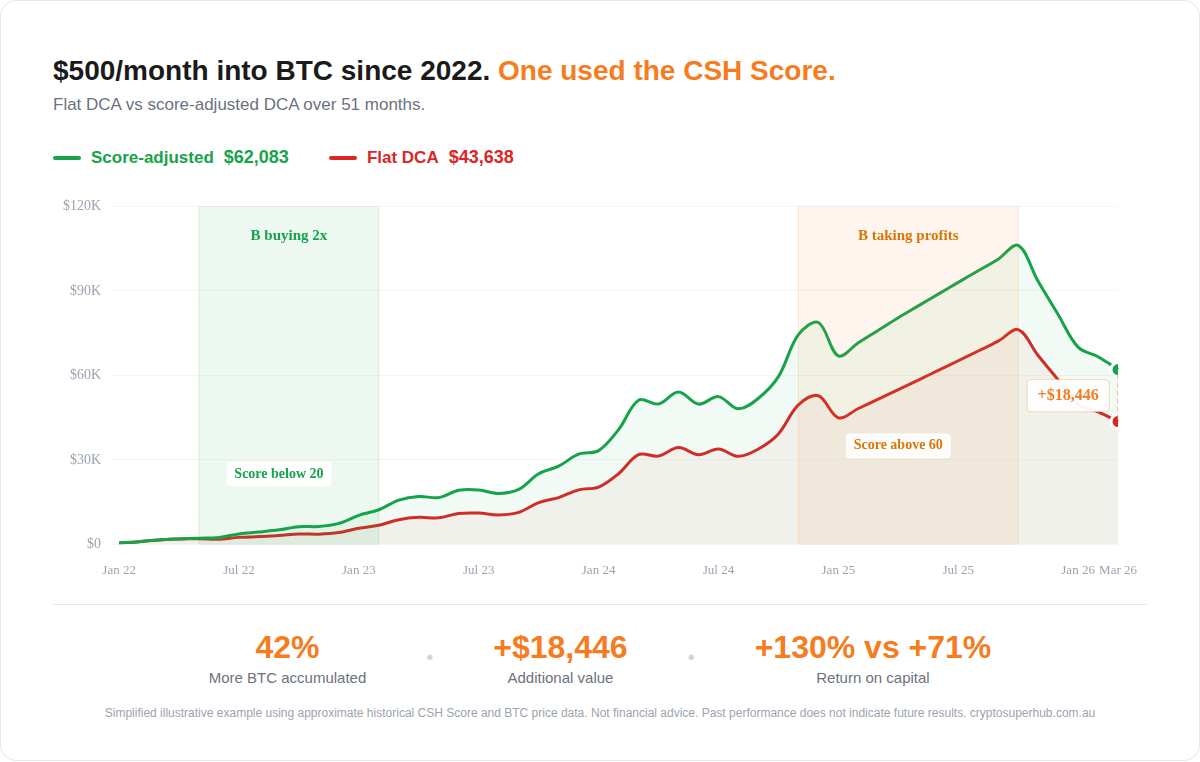
The difference isn’t skill. It’s the system. Investor B bought more when the score said conditions were cheap and sold when the score said conditions were expensive. That’s it.
That’s the entire point. Not calling tops and bottoms. Having a framework that tells you when to lean in and when to lean out, before your emotions make the decision for you.
The CSH Score has been below 30 almost continuously since February 4th. One brief wick above on March 17th, then straight back under. This week it dropped to 21. In 2022, the score sat below 30 for roughly six months before BTC bottomed. In 2018, similar duration. Eight weeks in, we’re early. Not late.
The Plan Builder inside CSH takes the current score, your risk profile, and your available capital, then calculates your monthly entry. Everyone’s situation is different. But at 21 with Extreme Fear at 9, the system is pushing toward the aggressive end of the accumulation range.
The people DCA-ing at $66K with a score of 21 while everyone else is frozen? They’re the ones who’ll look back on this period the way people look back on buying at $20K in 2022.
Ten weeks ago this was a spreadsheet. Now it’s a live score you can check whenever you want. The system doesn’t care about geopolitics or what crypto Twitter thinks. It reads the data.
Right now the data says accumulate.
Jake’s Workbench
We built the CSH Score for Bitcoin first because it has the deepest cycle data. The model needs historical depth to calibrate properly, and BTC has four full cycles of reliable price data to work with.
Now we’re building the same scoring framework for ETH, SOL, and XRP.
Each asset behaves differently through cycles. ETH correlates tightly to BTC but with higher beta. SOL tends to lead both alt rallies and alt declines. XRP does its own thing entirely. The scoring model needs individual calibration for each one.
Tom is deep in the data. We’ll share progress as we go.
In practice this means the same system that tells you when to accumulate BTC, but for ETH, SOL, and XRP. Same risk score. Same Plan Builder integration. Same approach to removing emotion from the decision.
Last week I wrote about why it’s too early to rotate into alts. The alt scoring system will eventually give you a data-driven signal for when that rotation makes sense. Not a guess. Not a feeling. A score.
Most crypto education gives you a coin pick and wishes you luck. We’re building the tools so you can make that call yourself.
Quick Hits
BTC circulating supply hit 20 million. On March 9th, the 20 millionth Bitcoin was mined at block height 939,999. Only 1 million BTC left to mine over the next 114 years. So what: the scarcity argument just got mathematically harder to dismiss. At a score of 21, you’re accumulating an asset that just crossed the 95% mined threshold.
SEC classified 16 crypto assets as commodities and the market sold the news. The March 17 ruling was the most significant regulatory development in crypto’s history. Then on March 27, the SEC’s deadline for 91 ETF applications landed on the same day as $13.5 billion in options expiry. BTC dropped from $72K to $66K. $300 million in longs liquidated. So what: structurally bullish, short-term painful. The commodity classification doesn’t get reversed. Every delayed ETF application comes back with stronger legal standing. This is 2024’s spot ETF approval all over again. BTC dropped 20% after that approval too and then hit new highs.
Iran war continues to pressure risk assets. Iran rejected ceasefire calls despite a 15-point US peace proposal mediated through Pakistan. Oil remains above $100 with the Strait of Hormuz effectively closed. Trump extended a deadline on striking Iran’s power plants to April 6. So what: this is the single biggest macro headwind for everything right now. BTC has held up better than most risk assets given the chaos. If a ceasefire materialises, the relief rally will be significant.
The Week Ahead
BTC is testing support in the $65-67K range after the sell-the-news dump from the SEC ruling. The $65,500 level is the line to watch. A sustained break below with heavy ETF outflows would signal something worse than a normal dip.
The Iran situation remains the single biggest variable for all markets. Trump’s deadline for Iran to reopen the Strait of Hormuz is April 6. That date could be a turning point or another escalation. Either way, oil above $100 keeps inflation pressure alive.
April CPI (mid-month) will be the first print capturing the oil price shock. If it comes in hot, rate cuts are dead for 2026.
Next FOMC is May 6-7. Powell’s term ends May 15. A Trump-appointed replacement would likely push for easier monetary conditions. The transition could be the biggest macro catalyst of Q2.
The system is live. The score is at 21. Sentiment is at 9.
Those are the lowest readings since this bear market began. None of that guarantees a bottom. BTC can go lower. But the system doesn’t try to pick bottoms. It identifies when conditions favour accumulation. Eight weeks below 30 with the score now at 21 and Extreme Fear at 9 is about as clear a read as the model gives.
The people who build positions during periods like this don’t do it because they’re brave. They do it because they had a plan before the fear showed up.
Jake
What’s your current DCA amount per month into BTC? Reply with a number. I’ll share the anonymous range in next week’s issue.