


Everyone I talked to this month was waiting for a September low. Bitcoin went the other way.
It had every excuse to fall. The Fed raised rates on Thursday morning our time, the first rise since 2023. The Bank of Japan went to its highest rate in 31 years the day after. The crypto market structure bill failed in the US Senate by one vote. The spot Bitcoin ETFs had their biggest outflow since June. And on Friday our time Bitcoin rallied more than 5% in a day, squeezed about US$190 million of short positions in an hour, and by Sunday was sitting back above its 50-week moving average for the first time since November.
The thing people skip is what that reclaim has meant before. So I went through our score history, every day since 2012, and pulled out every time Bitcoin closed a week back above the 50-week MA after a proper stretch under it. Six times. Four started a bull market. Two were traps. The tells that separated them are below, and so is where this one sits.
And I changed my own plan this week. I’ll tell you why at the workbench.
CSH Risk Dashboard
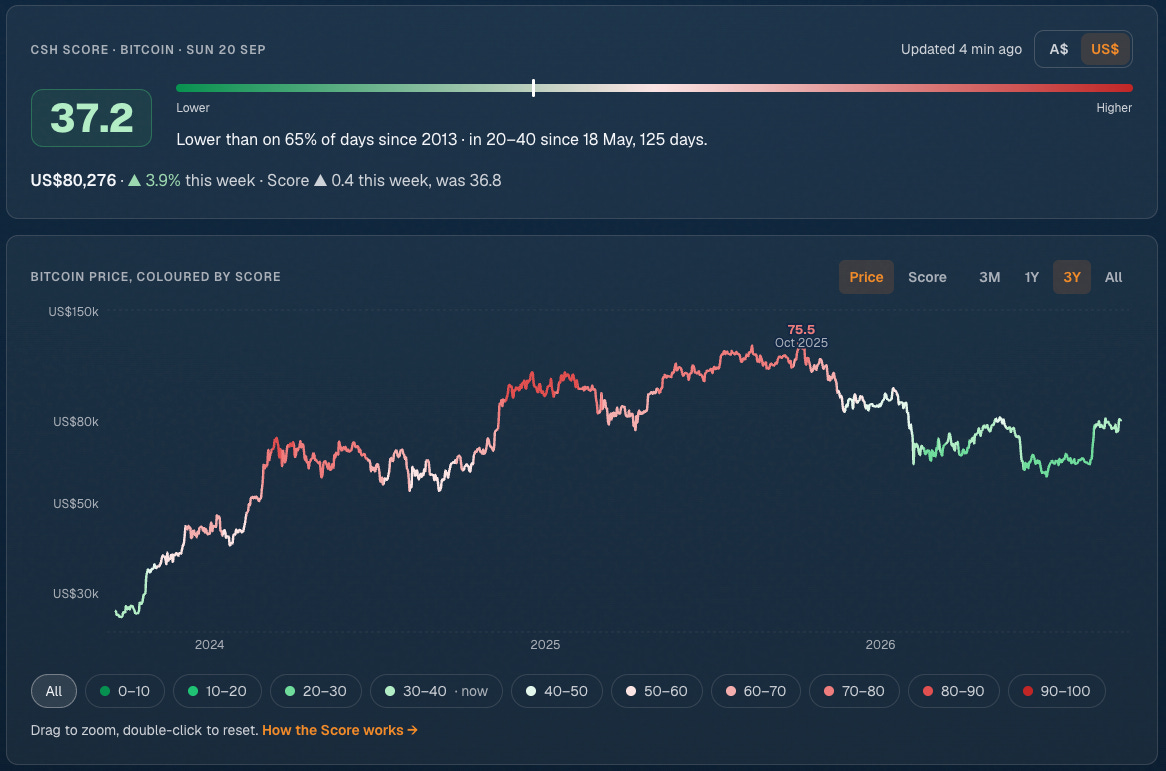
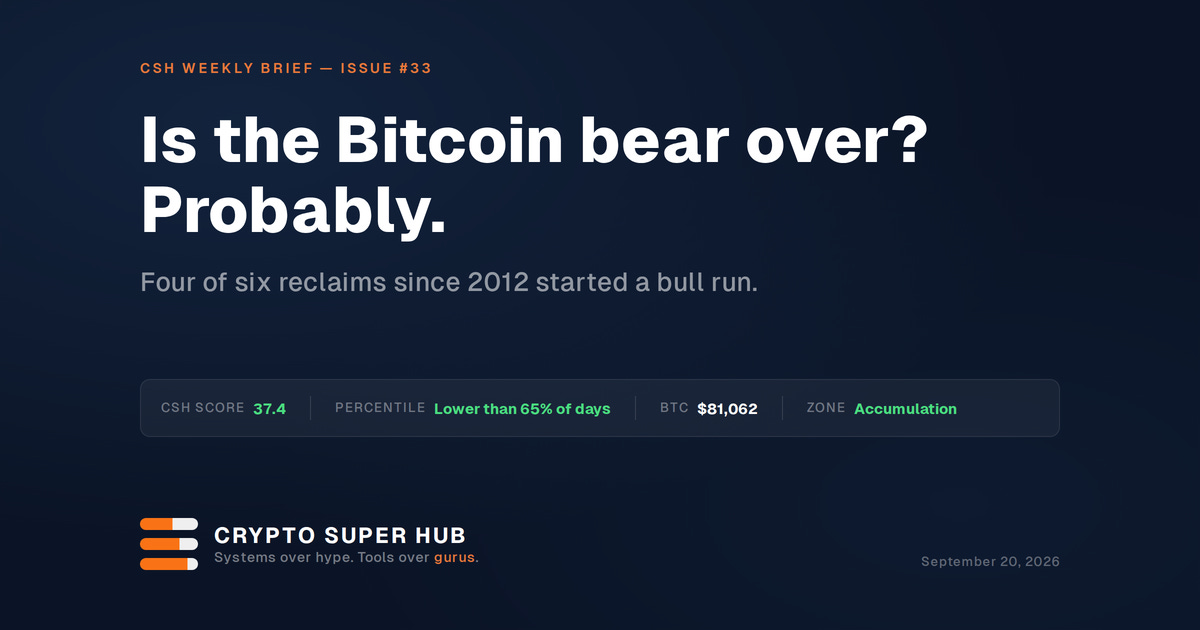
CSH Score closed the week at 37.4, up from 36.8 last Sunday. Lower than on 65% of days in our history.
Bitcoin: US$81,062 in our history on Sunday, about A$113,800. Up 4.9% on the week.
The 50-week moving average sits at about US$78,800 (TradingView, Bitstamp weekly, Sunday). Bitcoin is 3% above it. The weekly candle closes Monday 10am our time.
Support below: the bull market support band, about US$70,200 to US$72,600 on the same chart. A CSH Score of 30 is about US$69,700 today, so the band and a Score of 30 are stacked on top of each other again.
My plan: waiting, but with a wider net. It now buys between a CSH Score of 10 and 35 (it was 10 to 30 until Tuesday). A Score of 35 is about US$76,800 today. It hasn’t placed an order since August.
What the reading changes: the plan is 4 points and about US$4,000 from buying again. If we get the dip to the support band a lot of people are waiting for, that’s a Score around 30 and the plan buys on the Monday. If we don’t, the cash I’d set aside for a September low goes in on the plan’s schedule as the Score allows. I’m not calling the bear finished on one close. Consecutive weekly closes above the 50-week MA are the signal, and that’s still the test. But I stopped betting on a lower low this week, and the rest of this issue is why.
Six reclaims, four bottoms
In March 2023 I remember the exact feeling. Bitcoin had just closed a week back above its 50-week moving average at about US$27,000, and I was annoyed with myself. My SMSF had missed the November 2022 low at US$15,700 while the paperwork dragged, and now the price was 70% above it. Late to the party, I thought. Bitcoin went on to do nearly five times that price.
That’s the trap of the reclaim. It always arrives after the bounce, so it always feels late. So I wanted to know what it has actually meant.
The set-up is simple. Weekly closes since 2012. A reclaim is the first weekly close above the 50-week MA after at least a month under it. Then I measured what happened next.
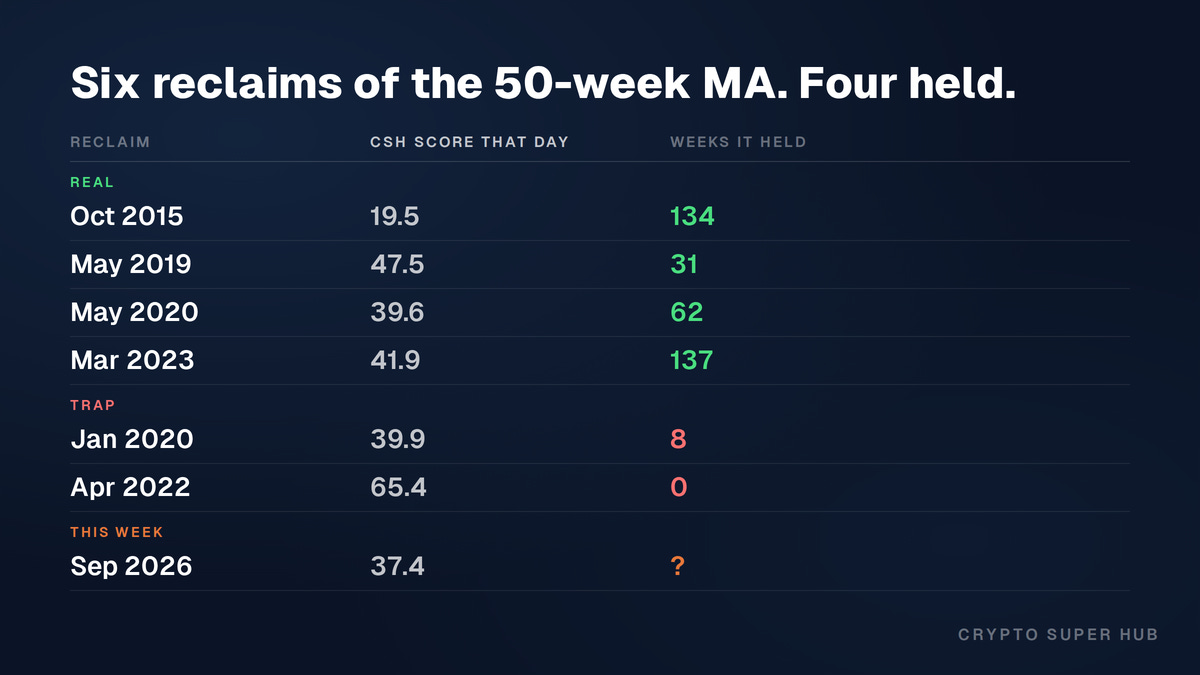
October 2015, CSH Score 19.5 on the day. Held above the average for 134 weeks. A year later, 2.3 times higher.
May 2019, Score 47.5. Held 31 weeks. A year later, 1.5 times.
January 2020, Score 39.9. Back under the average within 8 weeks, then the COVID crash took it 35% below the reclaim. A trap.
May 2020, Score 39.6. Held 62 weeks. A year later, 6.3 times.
April 2022, Score 65.4. Closed back under the average the very next week and fell 58% from there. A trap, and the one everyone remembers.
March 2023, Score 41.9. Held 137 weeks, until last November. A year later, 2.5 times.
Four real, two traps. The real ones held above the average for at least 31 weeks and never dipped more than 7% below the reclaim close in the following six months. The traps were back under within two months.
The tells
The candle itself told you less than I expected. The 2023 reclaim was enormous, 32% in a week, closing 17% above the average. But the May 2020 reclaim that started a 6x run closed just 2% above it. The 2022 trap closed 0.5% above. Size helps, but it isn’t the tell.
Two things separated the real ones from the traps.
First, how long Bitcoin had been under the 50-week moving average. The real reclaims came after about a year under it: 62 weeks, 49, 49, and the COVID one at 7 (a crash and a V-shaped recovery, not a bear). The traps came after 4 weeks and 13. A market that has spent a year under its 50-week MA has done its time, and a year is roughly what a Bitcoin bear takes: the last three ran 13 months, 12 and 12 from top to low, and the reclaim came four to nine months after the low. A market that dipped under for a month hasn’t done any of that.
Second, the CSH Score on the day. Every real reclaim fired with the Score between 19.5 and 47.5, meaning Bitcoin was still historically cheap when it turned. The 2022 trap fired at 65.4, historically expensive. It was a bear market rally inside a bear market, and the Score said so.
Depth of the bear is the one that’s mixed. The three big bears bottomed 77% to 86% under their top. The two shallow ones, 2019 and COVID, bottomed about 50% down, and one of those reclaims was real and one was a trap.
Where this one sits
Bitcoin has been under the 50-week average for 45 weeks. The CSH Score is 37.4. On the two tells that mattered, this looks like the real ones.
The low was 53% under the October top, which is the shallow-bear profile, and this week’s candle is on the timid side: 5% for the week, 3% above the average. The traps looked like that too. So did May 2020.
Here’s the number that stopped me waiting. At every real reclaim, Bitcoin was already 65% to 80% off its low. Every single one felt late on the day. A year later they were 1.5 to 6.3 times higher. This week we’re 38% off the July low.
So the plan is this. A weekly close back under the 50-week MA in the next eight weeks and it was a trap; both traps in our history failed inside that window. If that happens the plan keeps buying under 35 and I keep my mouth shut about bull markets. Consecutive closes above it that hold and I’ll say the bear is done, out loud, and the plan will have missed part of the move. That’s the trade I’ve always chosen. What I won’t do anymore is sit on cash waiting for a price the history says usually doesn’t come back. And even at US$81,000 the CSH Score says Bitcoin is still historically cheap: 37.4 is lower than on 65% of days since 2013. You don't need to perfectly time the exact bottom to make good money.
Jake’s Workbench
Three things this week.
One. I changed my plan. It bought Bitcoin under a CSH Score of 30. From 22 August the Score sat between 30 and 39, the plan did nothing, and Bitcoin went from US$78,000 to US$81,000 without it. So I went back to the score history and asked which buy threshold ends with the most Bitcoin, same sell rule, from three different start dates: 2017, 2019 and the November 2021 top. Under 35 won every time. Under 30 spends too long waiting. Since the start of 2023 there have been 134 days with the Score under 30 and 254 under 35, nearly double the buying days for the same money. Selling from 80 came first or tied first in every window too, so that end of the plan stays. The range is now 10 to 35. It took 20 seconds to change and a month of the plan sitting idle to realise I should.
Two. My own trades. The rebuilt Today page draws every buy I’ve ever made against the Score on the day. The ones I’m proud of sit in the 20 to 30 band. There are also dots in the 70 to 80 band from 2024 and 2025, when the Score said Bitcoin was historically expensive and I should have been taking profit, not adding. I built the tool and it still stung. That’s what it’s for.
Three. Two dates. On 6 September I wrote down the two conditions for changing my spare-cash rules: the 12-month mark from the 7 October 2025 top, and a weekly close above the 50-week MA that holds. The first arrives in 17 days. The second is being tested right now. Both in the same fortnight. If both land, the spare cash stops waiting for a lower low and goes in on a schedule too.
Product note: the app’s Today page was rebuilt this week. Your plan in one sentence with the next order, every trade you’ve imported drawn against the Score, and a trade file upload that takes exports from the main Australian and global exchanges.
Quick Hits
The Fed raised 25 basis points to 3.75–4.00% on Thursday morning our time, 12 votes to none, the first rise since 2023. One more is priced for December. Bitcoin’s low for the week came before the decision. It rallied through it.
The Bank of Japan went to 1.25% on Friday, its highest rate in 31 years. Same story.
The CLARITY Act, the US crypto market structure bill, failed its Senate procedural vote 49 to 50 on Tuesday. Bitcoin dipped under US$75,000 that day and was above US$81,000 by Friday.
Spot Bitcoin ETFs: US$450 million out on the day of the Senate vote, the biggest outflow since June. US$159 million back in two days later.
If you have a CSH account and this is the first Sunday brief you’ve received: we added app members to this list this week. It’s one email a week. Unsubscribe at the bottom if it’s not for you.
Week Ahead
Mon 21 Sep, 10am AEST: the weekly close. Above US$78,800 and the reclaim is on the board. The close after it matters more.
Thu 24 Sep, 11:30am: Australian jobs numbers (ABS).
Fri 25 Sep, 6pm AEST: quarterly options expiry on Deribit, about US$14.7 billion of Bitcoin options, heaviest open interest around US$72,000. One more reason the support band could get a visit.
Tue 29 Sep: RBA rate decision.
Wed 30 Sep, 11:30am: Australian monthly inflation (ABS).
Thu 1 Oct, 10:30pm AEST: US inflation (PCE).
Fri 2 Oct, 10:30pm AEST: US jobs report.
Wed 7 Oct: twelve months since the top.
Whatever those do, the plan’s answer is the same: under 35 it buys, over 80 it sells, in between it waits.
The Close
If the market has proven you wrong this month, don’t fight it. Early in a bull and late in a bear is when to take the most risk, and it never feels like it at the time. The way to actually do that, with a job and a family and no time to watch a chart, is to decide the rule now and let the schedule take the decision away from you.
Two weeks free to write yours down: the live CSH Score, the plan builder and your own record against the Score. Cancel before the trial ends and you’re not charged.
Crypto Super Hub is general information and education only. Nothing here is financial advice, and it doesn’t take your objectives, financial situation or needs into account. Crypto is volatile and you can lose money. Past performance doesn’t guarantee future results. Do your own research and consider speaking with a licensed financial adviser before making investment decisions. We hold Bitcoin ourselves, so assume we’re biased.