


Benjamin Cowen, one of the most respected analysts in crypto, posted on Monday: “I was wrong.” He’d been calling for a lower low in October. Bitcoin went through US$85,000 instead and he said so, in public, and copped a week of people dunking on him for it.
I was wrong too. Two weeks ago I told you I was leaning bearish into October and holding cash for it. Then Bitcoin closed a week back above its 50-week moving average, and this week it closed another 4% higher, sitting 8% above it. The market has answered the question, and it doesn’t care what I think.
There’s a line I keep coming back to: strong opinions, loosely held. Be fully committed to your view once you’ve made it, and drop it the moment the data says you’re wrong. The people who lose in this market aren’t the ones who get it wrong. Everyone gets it wrong at some point. They’re the ones who argue with the price for six months.
So this issue is the guide I wish someone had handed me in 2021. Where we are in the cycle, what each phase has looked like in the history, what the dips look like from here, and the do’s and don’ts that cost me real money to learn. Tom and I have fifteen years in crypto between us and nearly five of those at an Australian exchange watching people get this wrong at scale. If there was ever a time to pay attention, it’s now.
CSH Risk Dashboard
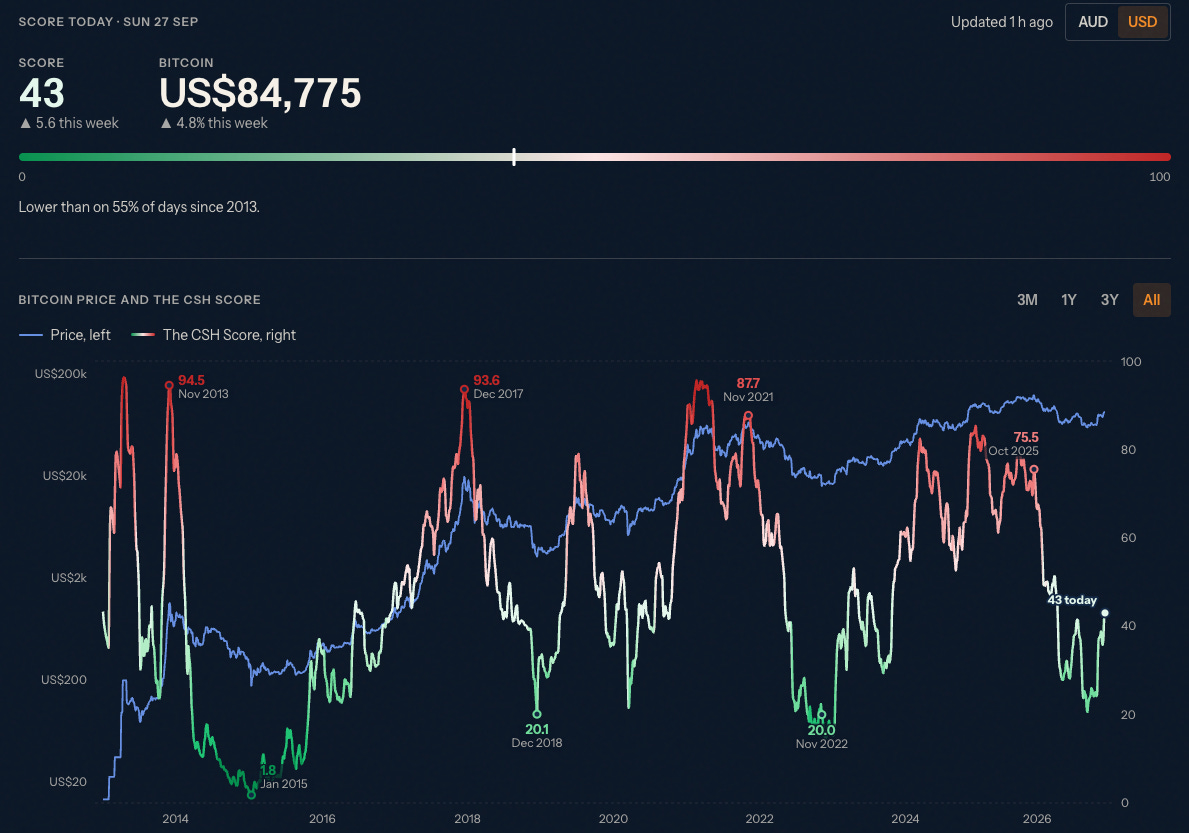
CSH Score closed the week at 42.9, up from 37.4 last Sunday. Lower than on 55% of days in our history.
Bitcoin: US$84,489 in our history on Sunday, about A$120,200. Up 4.4% on the week, 44% above the 1 July low, 32% under the October 2025 top.
The 50-week moving average is about US$78,200 (Bitstamp weekly). Bitcoin is 8% above it. Last week’s candle was the first weekly close above it since November. This week’s candle closes Monday 10am our time and would be the second.
The bull market support band, the 20-week average and 21-week exponential average, sits at about US$70,300 to US$73,700.
My plan: buys between a CSH Score of 10 and 35, and takes profit above 80. A Score of 80 is about US$152,000 at today’s map. No order since August.
What the reading changes: the plan bought nothing again this week, and that’s the problem. The history below says that once a bull market starts, the Score rarely comes back under 35. A plan waiting for it mostly sits in cash for a year. So I’m changing the buy range this week, and the spare cash I was holding for October is going in on a schedule. Details at the workbench.
Where we are
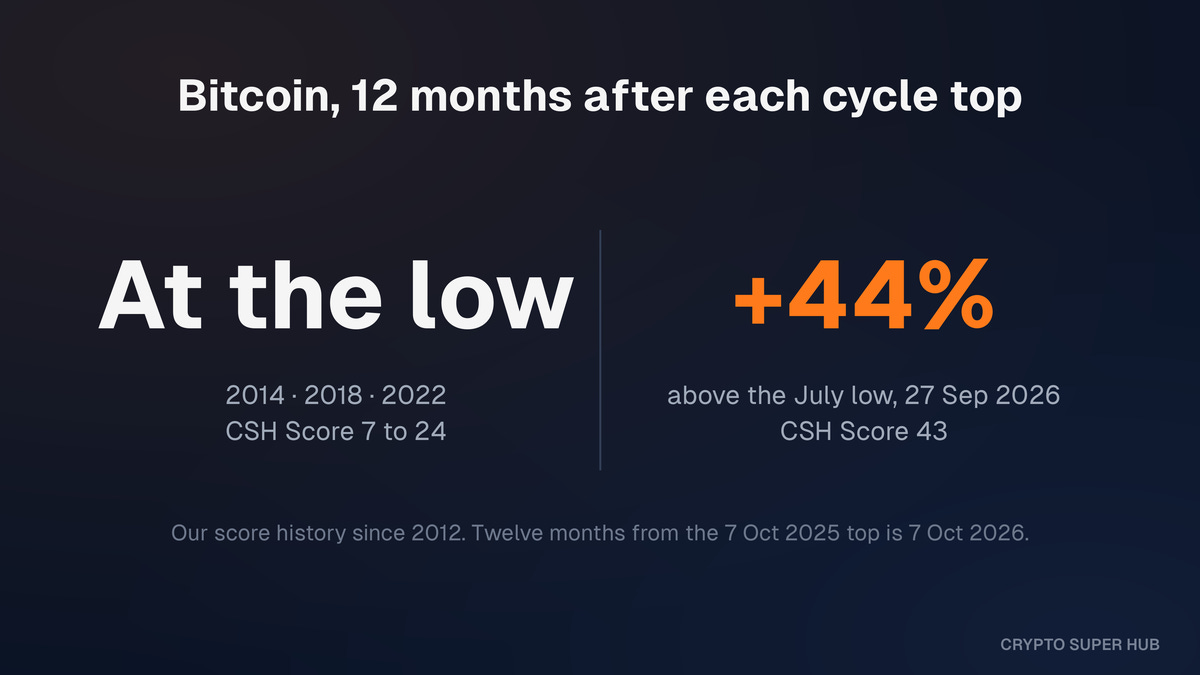
Twelve months since the top is Wednesday week, 7 October. So I went back and looked at what Bitcoin was doing at the 12-month mark of the last three tops.
December 2018, twelve months after the 2017 top: Bitcoin was at the low. The exact low was two days earlier. CSH Score 23.5.
November 2022, twelve months after the 2021 top: the low, to the day. Score 20.
November 2014, twelve months after the 2013 top: Score 6.8, 45 days before the low, and the price still had another 54% to fall.
Twelve months after every prior top, Bitcoin was at or heading into the bottom of its bear market. This cycle, ten days out from the mark, it’s 44% above a low that was set three months ago, and the Score is 43. That’s not a bear market at its low. It’s the shape of a bear that finished early, and shallow: 53% off the top against 76% to 83% in the last three.
The other signals point the same way. A weekly close above the 50-week moving average after 45 weeks under it, with the Score under 50 on the day, is the profile of every reclaim that started a bull market in our history. The one trap that fired with the Score at 65 was 2022; this one fired at 37. Add the ETF money coming back (US$2.4 billion into the US spot Bitcoin ETFs last week, the most since October 2025, per The Block on Friday) and the picture is consistent.
I’m not calling the bottom. I’m saying the probabilities have moved, and a plan should move with them.
The four phases
Every Bitcoin cycle in our history has run the same four phases. Here’s each one, with the numbers from the last three cycles.
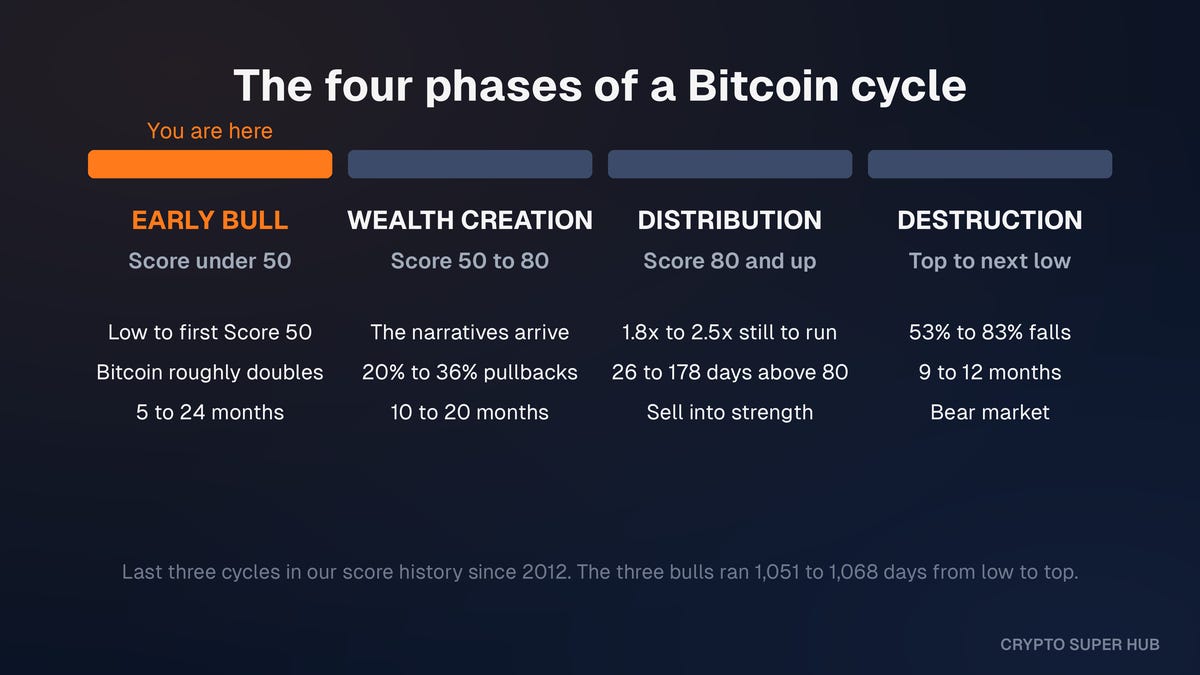
Phase one, early bull. From the low until the CSH Score first reaches 50. This is the quiet, boring, doubted stretch. It took 142 days in 2023, 146 days in 2019 and 720 days in the 2015 grind. Bitcoin roughly doubled from the low each time (1.9x, 1.9x, 6x in the long one). Nobody believes it while it’s happening. This cycle we’re 88 days from the low and the Score is 43. Still phase one.
Phase two, wealth creation. Score 50 to 80. This is where the money is made and where the noise comes back. In 2023 it ran from April 2023 to March 2024. The narratives arrive here: ICOs in 2017, DeFi and NFTs in 2021, the ETFs and the treasury companies in 2024. The biggest pullback inside this phase was 20% in 2023, 36% in 2017, and 61% in 2019 when COVID hit. Twenty per cent drops with the Score in the 60s are normal, not a signal.
Phase three, distribution. Score 80 and above. The first time the Score crossed 80, Bitcoin still had 1.8x to 2.5x left to run to the top, and between 25 days (2017) and 576 days (2024) to get there. That’s the part people get wrong about a sell rule: 80 isn’t the top, it’s the start of the part where you sell into strength. Each bull spent 26, 178 and 90 days above 80. That’s your window.
Phase four, destruction. The bear market: how far Bitcoin fell from the top to the next low, and how long it took. 83% in 363 days, 76% in 376 days, 53% in 267 days. The three bulls before this one each ran 1,051 to 1,068 days from low to top, seventeen days apart across three cycles. I’m not predicting this one matches. I am saying the shape has been the same every time, and the people who did well were the ones who knew which phase they were in.
What the dips look like from here
If we’re in phase one, here’s what the history says to expect. After each reclaim that started a bull market, the first twelve months had several pullbacks of 10% to 25%. 2020 had seven of them. 2023 had three, of 16% to 20%. 2015 had three, up to 32%. And in all three, Bitcoin never closed a single week back under the 50-week moving average. The dips bought back to the bull market support band, or close to it, and made higher lows.
The one that broke was 2019. By the time Bitcoin closed back above the 50-week moving average it had already rallied 80% off its low and the Score was 47, then it ran to 70 in seven weeks. That reclaim came late in the move, not early, and within a year Bitcoin had fallen 61% through COVID. This one came 38% off the low with the Score at 37, so it doesn’t fit that profile. But that’s the tell to watch: a weekly close back under the 50-week moving average, about US$78,200 today, and I stop calling it a bull.
So: expect dips. Plan for them. In a bull market they’ve been the best entries you get.
The do’s
Respect the trend. Bitcoin is above its 50-week moving average and its support band. Until a weekly close says otherwise, the trend is up, and the market doesn’t care what you thought in August.
Allocate early. Early in a bull and late in a bear is when you take the most risk, and you pull it back as the Score rises. I tested this against every reclaim that started a bull market. A plan that only bought under a Score of 35 bought nothing at all in the first year after the 2020 reclaim, and nine weeks out of 52 after 2023. The under-35 plan finished its first year with 79% to 100% less Bitcoin than a plan that bought the same amount every week regardless, and 19% less even in the slow 2015 grind. Spare cash spread over 13 weeks while the Score was under 50 got 96% to 99% of what going all in on day one got in 2020 and 2023, without the all-in risk, and 76% in 2015 and 2019 when the price ran faster than the tranches. The lesson is the reverse of the bear market one: cheap doesn’t come back on a schedule.

Be right and sit tight. Jesse Livermore’s line, and the hardest one. Once you’re positioned, the job is to hold through the 20% dips, not to trade them.
Write the exit before you need it. Mine is set in the plan builder already: taking profit above a Score of 80. Today that’s about US$152,000, and the number moves up as the cycle runs because the Score is measured against Bitcoin’s own trend. Set the rule now while you’re calm. When the Score is 85 and your group chat is a wall of screenshots, you won’t be.
Take profit into fiat. Altcoins into Bitcoin at the very least, but if you’ve made life-changing money, change your life. Buy the house. Pay down the loan. Put it into your business or yourself. The people who got hurt last cycle weren’t the ones who sold too early. They were the ones who held everything into the next bear because selling felt like quitting.
The don’ts
Don’t dwell on the bear market mistakes. I got mine wrong in 2021 and again this September. Fix the plan and move.
Don’t buy the winners you can see. Every screenshot of a 40x is one survivor from a crowd of people who lost. If you can’t find the denominator, assume the success rate is tiny.
Don’t keep buying a coin just because you already own it. If you wouldn’t buy it fresh at today’s price, sell it.
Don’t confuse a new narrative with a new paradigm. “Institutional adoption changes everything” was 2021’s line at US$69,000. The ETF floor at US$100,000 was 2025’s. Every cycle has one and every cycle reverts to trend.
Don’t wait for certainty. Waiting for the bottom to be confirmed is not the safe choice, it’s the one that cost the most in every cycle we have data for.
Don’t follow someone’s conviction. Mine included. Follow a rule you wrote down, and check the rule against the history, not against the loudest account you follow.
Don’t send your SMSF’s Bitcoin to a wallet you don’t control, and don’t chase yield. Luna, Celsius, Wonderland and Strongblock all paid me tuition on that one.
Jake’s Workbench
Three things this week.
One. I’m changing the plan again. The buy range goes from 10 to 35 to 20 to 45, and the spare cash I’d been keeping for an October low goes in over the next 13 weeks while the Score is under 50, on the plan’s schedule. The bottom of the range comes up because a Score under 20 almost never happens: since 2016 it’s been there for 110 days, all of them in the 2022 bear, and the last three cycle lows came in at 20.1, 20.0 and 20.6. A ladder that starts at 10 leaves orders waiting for a reading that doesn’t come. If a weekly candle closes back under the 50-week moving average, the spare-cash schedule pauses and the regular range keeps buying. Taking profit above 80 stays as it was. Two changes to the plan in a fortnight isn’t ideal. Sitting in cash through the start of a bull market is worse.
Two. The app. If you’ve logged in this week you’ll have seen it: new design, new logo, and the plan builder now takes a total. You set the amount you want to buy or sell, split it across the Score bands, and choose how big the first and last orders are. Every order gets marked filled as its band is hit. Plus an “I bought it” button that logs an order without a file upload. That’s the tool I’m using for the spare-cash schedule above.
Three. Paid switches on Thursday night. Every existing account gets a full 14-day free trial from the moment it flips, and the first 100 members lock A$19 a month for as long as they stay. After that it’s A$29. Tom and I both work full time, and we’ve put two years of nights and weekends and a fair bit of our own money into this. We love it and we’d also like it to pay for itself. More on that at the close.
Quick Hits
US spot Bitcoin ETFs took in US$2.4 billion last week, the biggest weekly inflow since 10 October 2025, and turned positive for the year. Monday alone was US$999 million (The Block, 26 Sep).
Cowen again, because it matters: he said on Monday he was wrong about a Q4 low and that he deserved to be dunked on. I’d rather follow someone who admits they were wrong than someone who deletes the tweet.
CBA’s economists moved their RBA call forward: a 25 basis point rise to 4.60% on Tuesday, on oil above US$100 and inflation running hotter than the RBA expected (CBA, 21 Sep). Markets have it at about 90%.
Bitcoin is 44% above its July low and the CSH Score is 43. The last three times the Score first crossed 43 in a new cycle, the top was still 4.4x to 28x away and 18 months to two and a half years out. Not a prediction. A base rate.
Week Ahead
Mon 28 Sep, 10am AEST: weekly close. Above US$78,200 and it’s the second close above the 50-week moving average.
Tue 29 Sep, 2:30pm AEST: RBA decision. A hike is priced.
Wed 30 Sep, 11:30am AEST: Australian monthly inflation (ABS).
Thu 1 Oct, 10:30pm AEST: US inflation (PCE).
Fri 2 Oct, 10:30pm AEST: US jobs report.
Thu 1 Oct, night: Crypto Super Hub goes paid.
Wed 7 Oct: twelve months since the top.
Whatever those do, the plan’s answer is the same: under 45 it buys, over 80 it takes profit, in between it waits.
The Close
Two years of Sunday nights went into this and it has never cost anyone a cent. On Thursday night that changes. Crypto Super Hub goes paid: two weeks free for everyone, nothing charged until day 15, then A$19 a month for the first hundred members, held for as long as you stay. After the hundred, it's A$29.
For that you get the CSH Score, the plan builder with the buy and sell ladders, every trade you've made drawn against the Score, and the exchange file import. Less than most people spend on streaming. About four coffees.
There's no discount and no countdown, because the price is the price and the hundred is real. When they're gone, it's A$29 and it stays there.
Tom and I have been building towards this week for two years, and it's landing at the start of what the history says is the best part of the cycle to have a plan. The Score, the plan builder with both ladders, your own trades drawn against the cycle, and every Sunday brief from here, for a few coffees a month. If you've read these on a Sunday night thinking you should sort your plan out, this is the week. Start the trial, build the plan, and let's do this bull market properly.
Crypto Super Hub is general information and education only. Nothing here is financial advice, and it doesn’t take your objectives, financial situation or needs into account. Crypto is volatile and you can lose money. Past performance doesn’t guarantee future results. Do your own research and consider speaking with a licensed financial adviser before making investment decisions. We hold Bitcoin ourselves, so assume we’re biased.