

Crypto Super Hub — Weekly Market Intelligence | 17 May 2026
I’m going to be honest with you. When I read the Budget papers on Tuesday night and saw Labor was scrapping the 50% CGT discount, my first thought was simple: this is structurally bad for Australia.
Halve the discount. Add a 30% minimum tax floor on top. Replace what’s left with cost base indexation. The signal it sends to anyone trying to build, invest, or compound long-term capital in this country is the wrong one. Builders read these signals. They move.
This isn’t just bad for crypto investors. It’s bad for every Australian trying to invest outside super.
But buried in the Budget papers is one line almost every mainstream piece missed. SMSFs are excluded. The 33% super discount stays. The 15% accumulation rate stays. The 0% pension rate stays.
That’s the silver lining.
While individuals just had their effective crypto tax rate jump from around 23% to a range of 30-47%, the gap between holding BTC personally and holding it in your SMSF just got materially wider. The same Budget that created the problem handed crypto investors the obvious solution.
The case for holding crypto in Australia got weaker this week. The case for holding it inside an SMSF got significantly stronger.
CSH Risk Dashboard
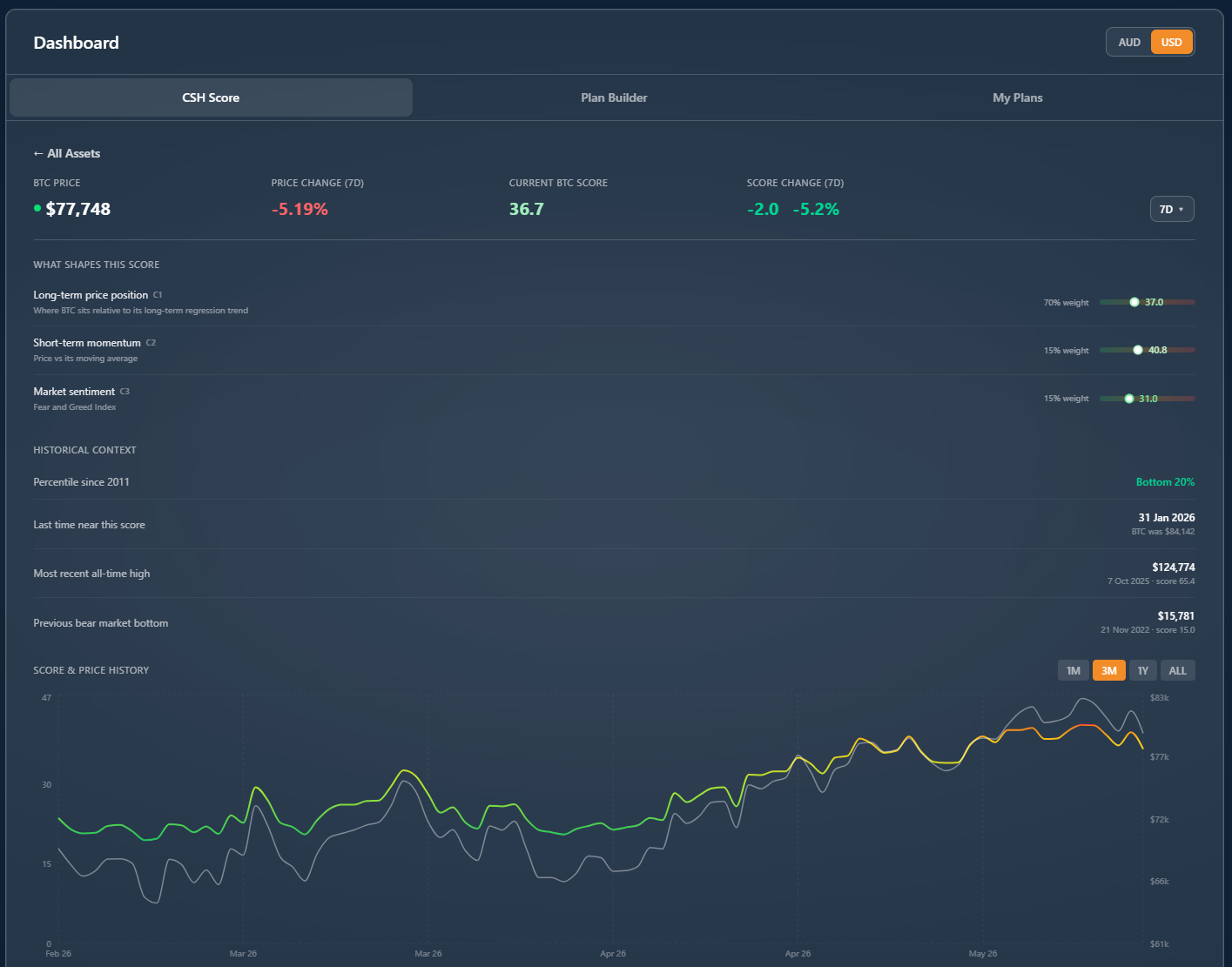
Current CSH Score: 36.7 (down 2.0 points over the last seven days, -5.2%)
BTC Price: US$77,778 (down 5.05% on the week)
Percentile Since 2011: Bottom 20%
Score breakdown: long-term price position 37.0 (70% weight), short-term momentum 40.8 (15%), market sentiment 31.0 (15%, Fear & Greed in Extreme Fear).
Last issue I asked if this was a bear market rally. The 200-day moving average answered for me. BTC tested the 200-day around US$82,000 four times across two weeks. Rejected four times. It broke below US$80,000 last Thursday and has stayed below ever since. As of Sunday, BTC sits around US$77,800.
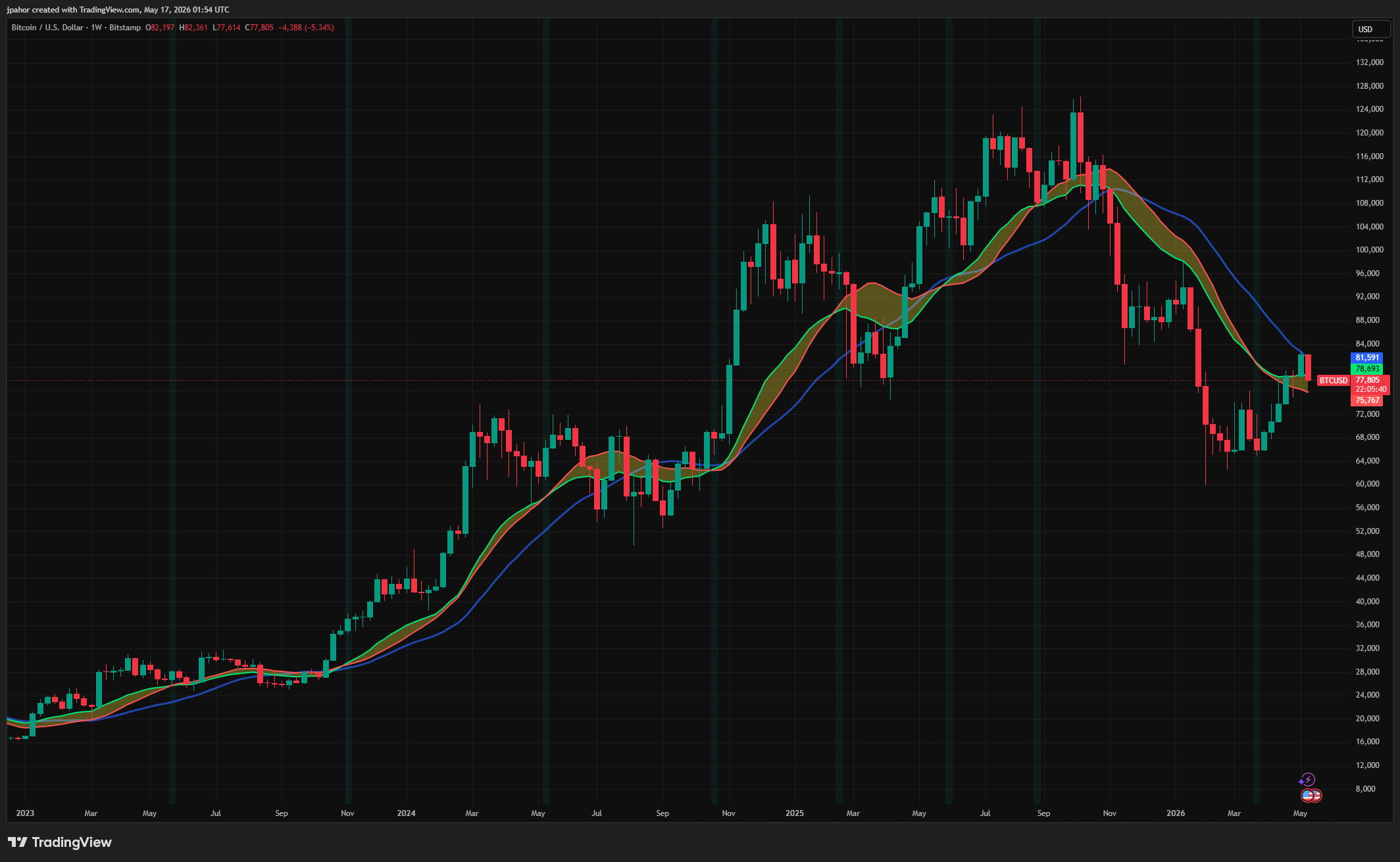
That’s textbook bear market rally behaviour. Sharp rally from local low. Test of major resistance. Failure. Roll over.
That said, BTC is now sitting right in the middle of the Bull Market Support Band, between $78,693 (20-week SMA) and $75,767 (21-week EMA). That band has consistently marked key support during crypto bull markets. Hold it on a weekly close, and the bull thesis stays intact. Lose it, and we’re in a different conversation.
The score doesn’t care about the rejection though. At 36.7 we’re in the Bottom 20% of all readings since 2011. The last time we sat near this level was 31 January 2026 when BTC was at US$84,142, about 8% higher than today. Buying at scores in this band has historically worked.
Plain English read: technical structure says the rally has failed. The score says we’re still well inside the buy zone. Both can be true. The system buys low scores regardless of what the candle looks like.
Why Super Walked Free
Here’s the part of the Budget the headlines glossed over.
From 1 July 2027, Labor is replacing the 50% CGT discount with cost base indexation plus a 30% minimum tax floor on capital gains. The reform applies to individuals, trusts and partnerships. Gains realised before 1 July 2027 still get the 50% discount, so it’s not retrospective.
The 30% isn’t a ceiling. It’s a floor. There’s no path under it for individuals. No matter how long you hold, no matter what your marginal rate would otherwise be, your gains get taxed at at least 30%.
But here’s the bit you need to know if you’re an Aussie crypto holder.
Super funds, including SMSFs, are explicitly excluded.
The Treasury fact sheet and budget papers carve them out. SMSFs keep their existing 33% CGT discount on assets held more than 12 months. They keep the 15% income tax rate in accumulation phase. They keep the 0% rate in pension phase.
Let’s do the maths on what that means for crypto held longer than 12 months.
Outside super, top marginal taxpayer:
Pre-reform: 47% marginal × 50% discount = roughly 23.5% effective
Post-reform: 30-47% effective. The 30% acts as a floor. The marginal rate after indexation acts as a ceiling.
That’s a jump of anywhere from 28% to nearly 100% on the same gain.
Inside SMSF, accumulation phase:
15% income tax × 67% (after 33% discount) = roughly 10% effective
No change
Inside SMSF, pension phase:
0% effective
No change
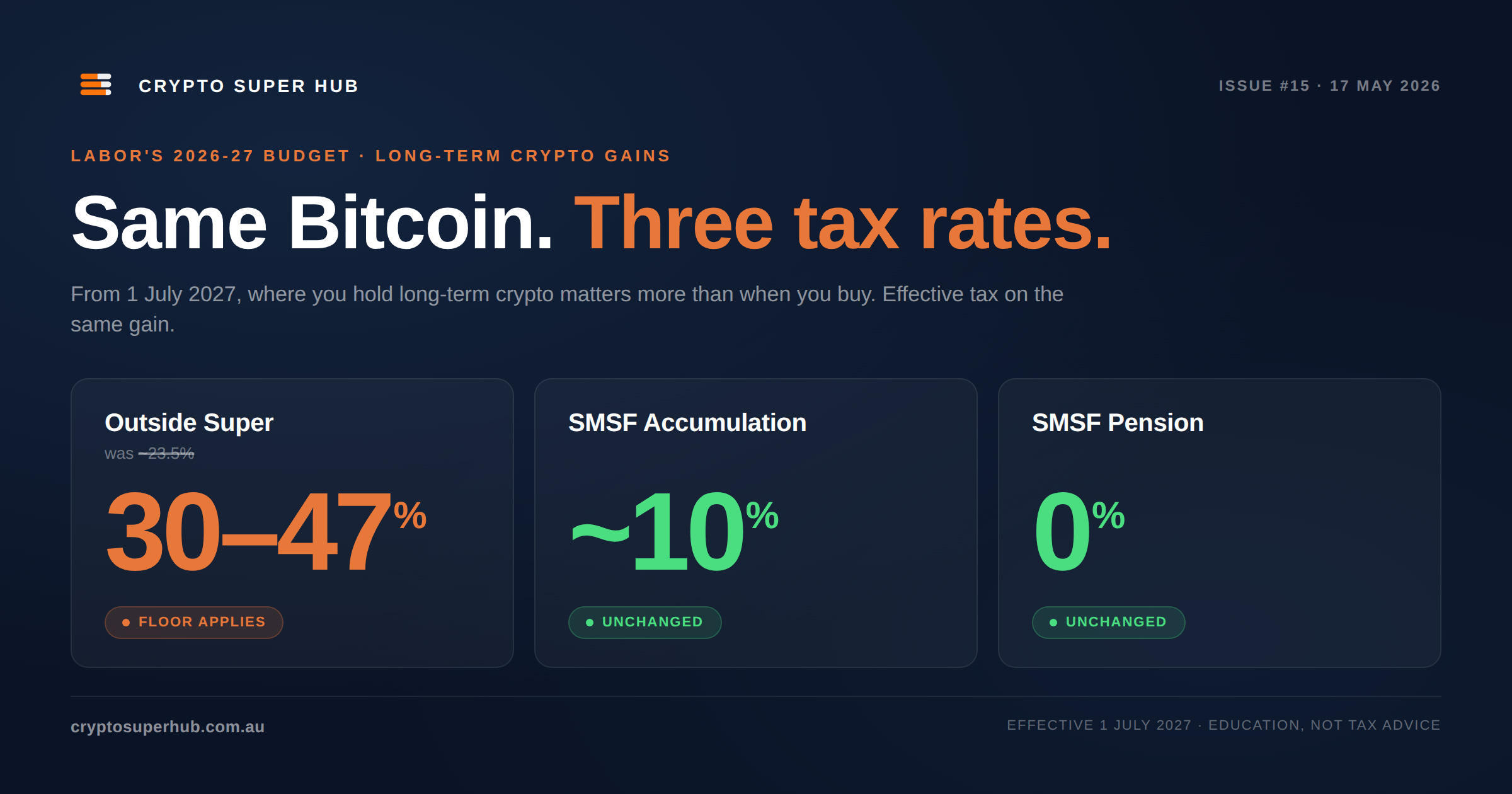
The gap between holding BTC personally and holding it in your SMSF has roughly doubled in width. That’s not a minor adjustment to your retirement planning. That’s a structural reframe of where you should hold long-duration crypto if you’re an Australian investor.
A caveat. These changes are proposed in the Budget, not yet legislated. They need to pass Parliament. The 30% floor and indexation maths get complex once you layer in non-resident provisions, trust distributions, and small business concessions. If you’re considering restructuring or starting an SMSF specifically for crypto, talk to a licensed financial adviser and an SMSF specialist accountant. CSH is education, not advice.
But the strategic question this week isn’t whether to buy. The score says you can. The strategic question is which account you should buy it in.
Jake’s Workbench
Plan Builder went live three weeks ago. The timing for this Budget news is accidental but useful.
Here’s the workflow I’ve been running since Tuesday. Open Plan Builder, set the BTC amount you want to deploy this cycle, choose Adaptive scaling. The tool weights buys toward lower scores. More allocated at scores below 40 (today’s 36.7 qualifies), less above 60.
The argument for Adaptive over Static DCA isn’t that it always wins. Across 22 historical entries in the 35-50 band, it beat Static DCA on win rate (91%) and outperformed on drawdown protection.
Now layer this week’s tax change on top. Running an Adaptive plan inside an SMSF, the calculus sharpens. Lower entries, plus a 10% effective tax on the eventual gain. The maths compounds differently from outside-super crypto, where you’re now looking at 30-47% on the same gain.
This isn’t an argument to rush an SMSF setup. They have real costs and ongoing compliance. It’s an argument to model both scenarios properly before 1 July 2027. Existing assets get grandfathered. The clock matters.
Quick Hits
Clarity Act cleared the Senate Banking Committee 15-9 on Thursday. Two Democrats joined all 13 Republicans, including Senators Gallego and Alsobrooks. The bill still needs to clear the full Senate (60-vote threshold), pass the House, and reach the President’s desk. White House target is signing by 4 July. BTC initially rallied to around $82,000 on the news, then sold off below $80,000 within 48 hours and hasn’t reclaimed it since. So what: US market structure clarity is bullish over 12-24 months, not 12-24 hours. Don’t trade the headline.
BTC rejected at 200-day MA for the fourth time in two weeks. The 200-day sits around $83,000. BTC hasn’t closed above it in seven months. Analyst Benjamin Cowen compared the setup to 2018, which tested the 200-day in a bear market rally and rolled over. So what: technicals confirm we’re still in a downtrend until the 200-day breaks. The CSH Score has been reading this for weeks.
BTC drawdown now sits at 37.7% from the $124,774 ATH on 7 October 2025. For context, the 2022 bear drew down roughly 77% from $69K to $15,781. The 2018 bear drew down roughly 84%. We’re not there. So what: “deep enough” is relative. The score is in the Bottom 20% percentile, but BTC has historically gone deeper.
The Week Ahead
Watch BTC vs $80,000. That level held through April. Lost on Thursday and BTC has stayed below ever since. Reclaiming it on a daily close is the first stabilisation signal. The next support levels are $75,800 (Strategy’s average corporate cost basis) and $71,500.
CSH Score recovery to 40+. Today’s 36.7 sits well below the 40 threshold. A move back above 40 with BTC stabilising would confirm short-term momentum is shifting. Below 35 means we keep accumulating into deeper fear.
SMSF chatter is about to spike. Aussie financial advisers will be busy modelling the new CGT maths. Expect more SMSF crypto discussion in the next month than you’ve seen all year. Some of it will be sales-driven by SMSF promoters. Filter accordingly.
The Close
Last issue Richard asked in the comments whether the lower low was still coming. The honest answer from this week’s data: the 200-day rejection makes another leg down more likely than less likely. The score will catch it if it happens.
Three weeks ago we launched Plan Builder for exactly this kind of environment. Low scores. Volatile structure. A clear case for Adaptive scaling. If you haven’t set it up yet, that’s the action this week.
If this issue helped you think more clearly about your structure, hit the heart at the bottom. That’s how Substack decides who else sees it.
Jake
yes - how to set up a SMSF and move current personally help Bitcoin into SMSF without triggering CGT. Financial advisors are a little busy this week but hope to speak to one soon.