


If you’ve opened the app since Saturday, your CSH Score looks different. That’s because Tom and I upgraded the model behind it.
It’s still one number from 0 to 100, and it still does one job: it shows where Bitcoin’s price sits between a floor and a ceiling built from its own history. What changed is how well it reads that history. Every past reading has been worked out again on the new model, so the whole chart is on one scale, and any plan you’ve saved now runs on the upgraded Score.
Changing the model a few days after we switched paid on isn’t great timing, and I’d rather tell you that straight. Sitting on a better one because the timing’s awkward would be worse. All models are wrong, but some are useful, and this upgrade makes ours a lot more useful.
So the first thing I did was run my own plan against it. Two of my numbers didn’t survive. Here’s what changed, and why.
CSH Risk Dashboard
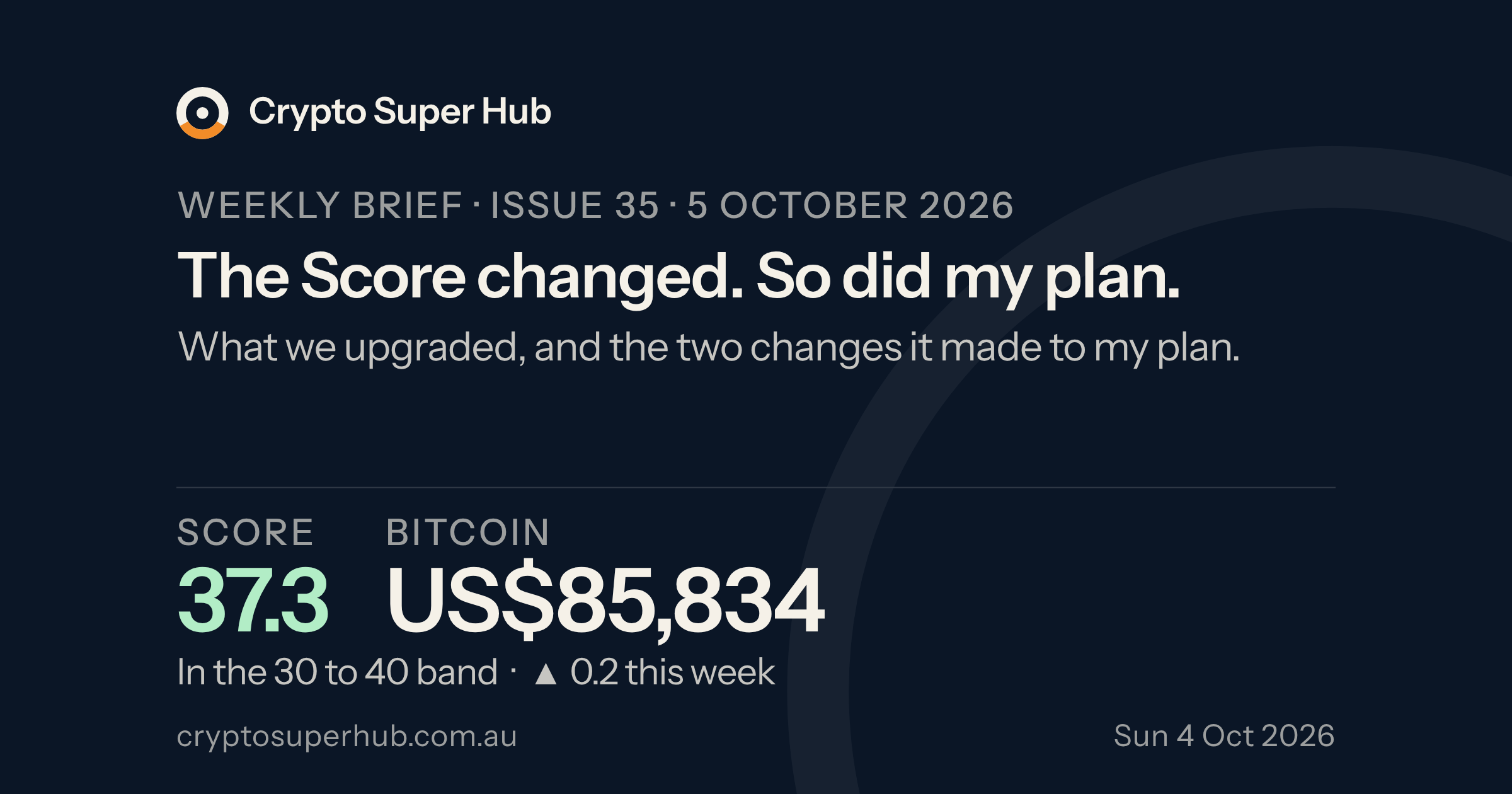
The CSH Score closed the week at 37.3 on the upgraded model, up from 37.1 last Sunday on the same model. Last week’s issue said 42.9: that was the old model.
Lower than on 51% of days since 2013.
Bitcoin: US$85,834 on Sunday in our history, about A$123,700. Up 1.7% on the week.
A third weekly close in a row above the 50-week moving average, which sits at about US$77,200 (Bitstamp weekly).
The bull market support band, the 20-week average and 21-week exponential average, is about US$71,200 to US$75,900.
My plan from this week: buys anywhere under a CSH Score of 45 and takes profit above 75.
What the reading changes: the plan bought last Monday, its first order since August, and it buys again this week because 37 is inside the range. A CSH Score above 45 pauses the buys. Above 75, it starts taking profit.
What the upgrade changed
Every Bitcoin cycle has grown less than the one before. From the low to the top, Bitcoin went up about 110 times in the 2015 to 2017 bull market, 21 times in the next one, and 8 times in the last. That’s diminishing returns, and the old model didn’t allow for it. So each cycle top read a little lower than the one before, and by October 2025 the top only read 75.5. High, but not high enough to flag the end of a bull market.
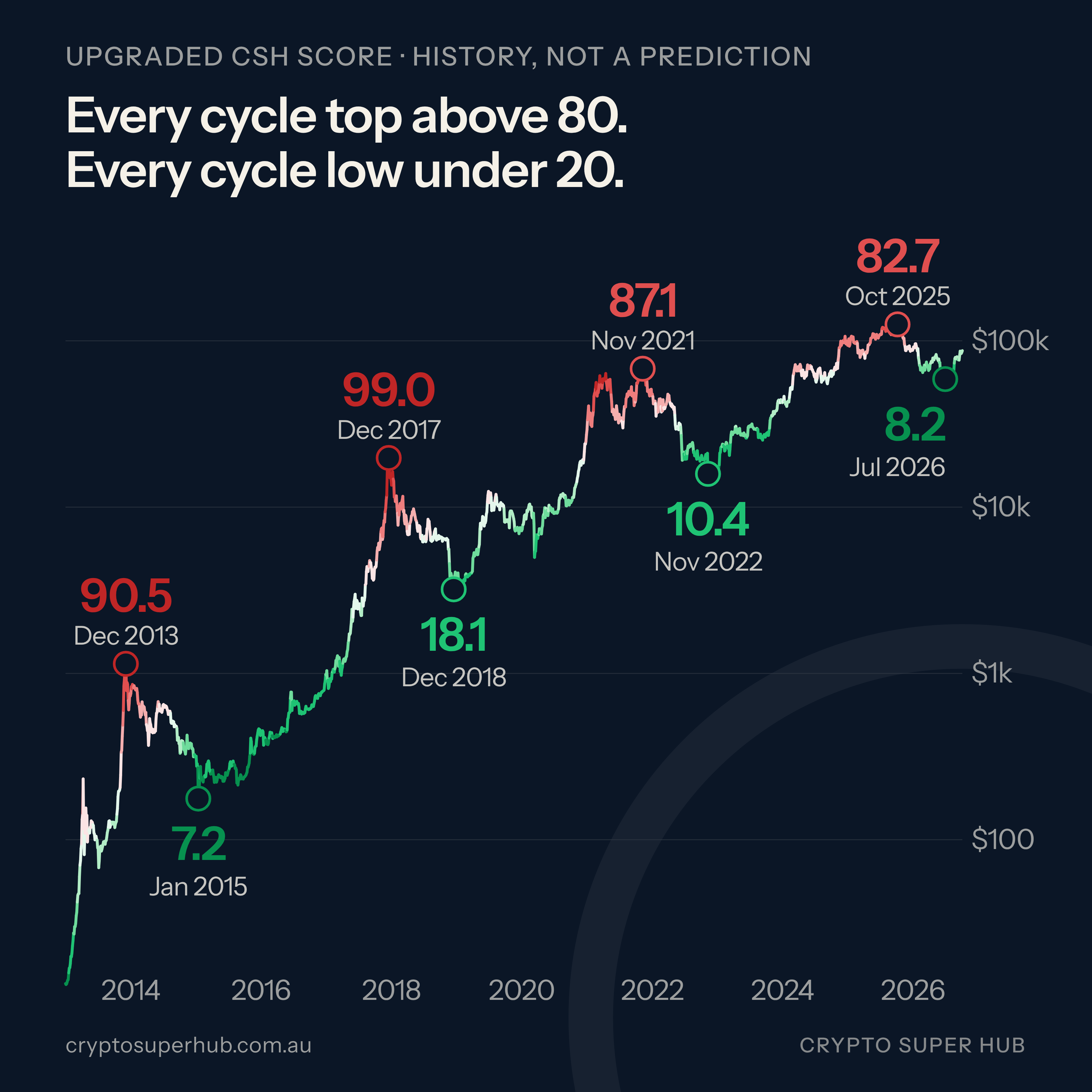
The upgraded model allows for diminishing returns. Every cycle top since 2013 now reads above 80, and every cycle low reads under 20. If the next cycle grows less again, the CSH Score should still read as high at the top as it did at the last ones.
It’s also steadier. The Score now only moves when Bitcoin’s price moves. On the old model there were 27 days when the Score shifted 5 points in a week while the price went nowhere. On the upgraded model there are none.
We don’t plan to change it often. The settings get reviewed when a cycle has clearly turned or at a planned checkpoint, never mid-cycle because the market feels different. If it does change, it goes on the About page with the date, and the whole chart gets worked out again.
One honest limit, same as always: the Score compares today’s price with Bitcoin’s own history. It isn’t a forecast, and it can’t tell you whether Bitcoin is a good investment. That part’s your call.
What it changed in my plan
Here’s what I was running before the change: a buy plan between a CSH Score of 20 and 45, and a sell plan taking profit above 80.
The floor at 20 had to go. On the old model, the last three cycle lows read about 20, so a range starting at 20 caught the bottom. On the upgraded model, those same lows read 18.1, 10.4 and 8.2. A plan that stops at 20 would now stop buying right when Bitcoin was lowest in its range. So my plan buys anywhere under 45, with bigger orders the lower the Score goes.
Why such a wide range? Because nobody knows where the bottom is, and people start at different points in the cycle. Take a new SMSF with cash ready to go today. The CSH Score is 37, three months after a low of 8.2. Waiting for it to get back under 20 could mean waiting a very long time. In the last three cycles, once the Score had climbed back to 37 after a low, it only went under 20 again once, on 32 days around the March 2020 COVID crash.
The low stretches also run a lot longer than the high ones. Since 2016 the CSH Score has spent 2,146 days under 45 and 486 days above 75. Bear markets and early bull markets drag on. Tops come and go quickly.
That’s why taking profit moves from 80 to 75. The 2025 top read 82.7. In that whole bull market the CSH Score spent 46 days above 80 and 203 days above 75. A rule that waits for 80 barely gets a chance to sell.
The top of the buy range stays at 45. Stopping at 40 did better over the full history because it kept more cash back for the bear markets, but from 2023 on, 45 did as well or slightly better. I’ve changed this plan twice in a month already, and I’m not changing it a third time for a small difference. I’ll look at it again when the Score first reaches 50.
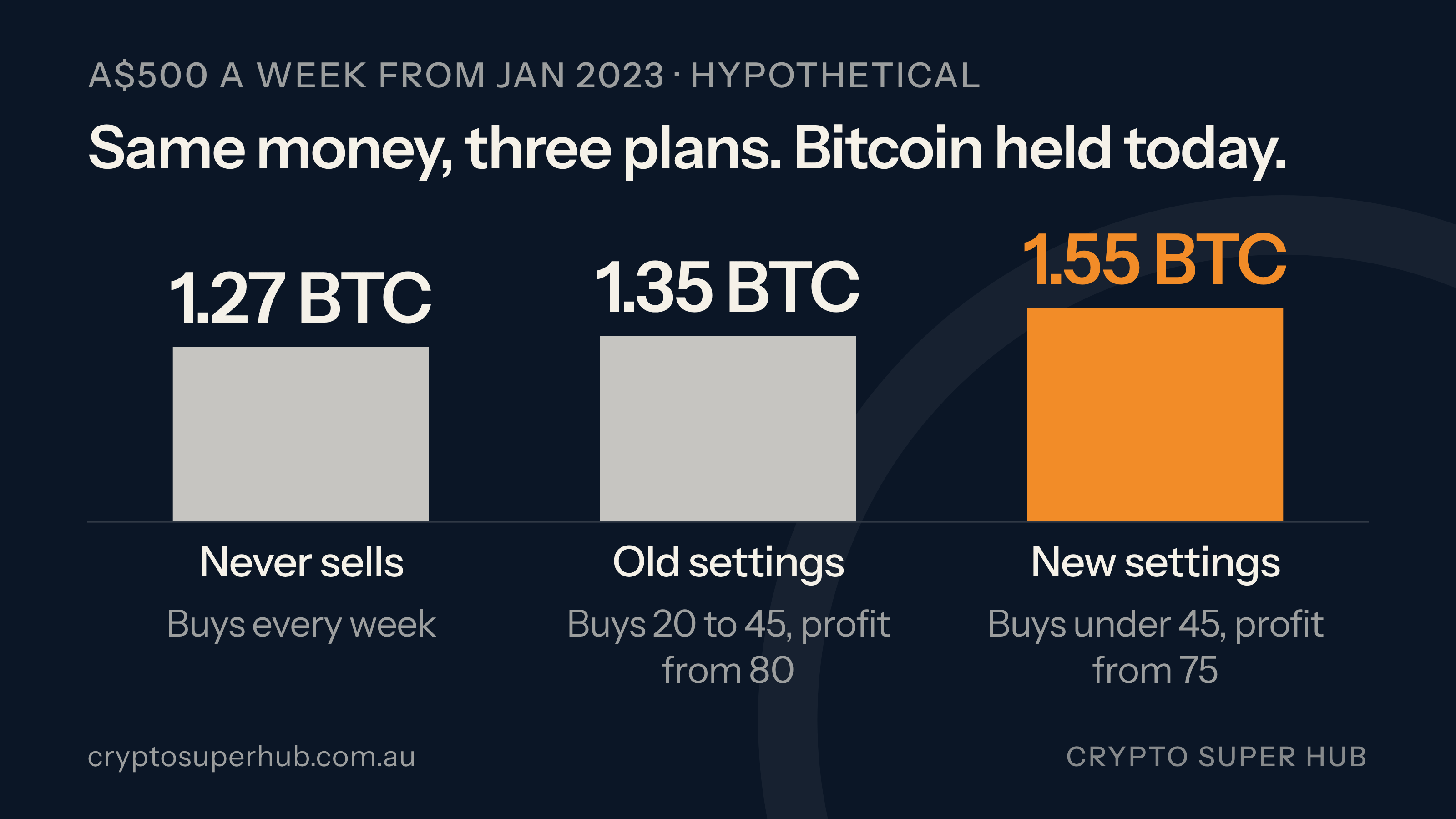
To check all this, I ran three hypothetical investors through the upgraded history from January 2023, when I started buying in my SMSF. Each puts in A$500 a week, A$98,500 so far.
One buys every week and never sells (HODL): 1.27 Bitcoin today, about A$158,800.
One runs my old settings on the new Score, buying between 20 and 45 and taking profit from 80: 1.35 Bitcoin, about A$173,300.
One runs the new settings, buying anywhere under 45 and taking profit from 75: 1.55 Bitcoin, about A$194,000.
Here’s the catch. With the new settings, the plan started taking profit in late November 2024, with Bitcoin just under US$99,000. Bitcoin kept climbing for another ten months and topped 27% higher. At the top, this investor held less than half the Bitcoin of the one who never sold, with about A$82,900 sitting in cash. That would have felt wrong for most of a year. Then the bear market came, and the cash bought back in at much lower prices in February and March 2026.
I ran the same test from eight different start dates between 2013 and 2024. The new settings finished ahead of the old ones from every one of them.
One warning, and it matters more than normal here. Every reading in the Score’s history has been worked out after the fact with today’s model, not read live at the time. So this backtest is a fair test of the rules against past cycles, with the benefit of hindsight on the Score. It isn’t a promise about the next cycle.
Jake’s Workbench
If you built a plan before Saturday, it now runs on the upgraded Score, and it’s worth five minutes. A floor of 20 on the new Score is a different plan to a floor of 20 on the old one.
Here’s what the plan builder does with your number:
You set a total to buy, or a total to sell.
It ladders that total across 5-point bands of the CSH Score.
You choose how big the first and last orders are.
It marks each order filled as its band is hit.
It now shows the dollar price behind each band too, so a range turns into prices you can actually picture. Today a CSH Score of 45 is about US$91,900 and 75 is about US$125,000.
Why the sell side matters so much to me. Last year I spoke to hundreds of SMSF trustees putting six-figure lump sums into Bitcoin near the top, set and forget. On the upgraded model, the CSH Score sat above 75 on 111 of the 123 days from July to October 2025. I wasn’t above it either. I bought at the end of August last year with the CSH Score at 76, and again in November at 68. Small buys, but made with my gut, not my head. With the plan I run now, August was a month for taking profit and November was a month for waiting.
A good mate who’s setting up an SMSF asked me over the weekend why he shouldn’t just buy the same amount every month and forget about it. For the S&P 500, I mostly agree. It doesn’t fall by half every four years. Bitcoin has fallen by at least half after every cycle top in our history, most recently 53%. A plan that sizes each order to the Score uses that volatility instead of just sitting through it. It’s the middle ground between staring at charts twelve hours a day and buying blind.
Quick Hits
From the desk: Australian banks blocking transfers to crypto exchanges is getting worse. Frozen accounts, closed accounts, and customers grilled for hours on the phone and made to feel like criminals for moving their own money to a licensed, regulated Australian exchange. I’d love to say these calls are one-offs. They happen every day. If you’re moving a large amount: use a licensed Australian exchange registered with AUSTRAC, and have its account details and AUSTRAC registration ready before the fraud team calls, because they will. Be polite, answer honestly, don’t overshare. It’s frustrating, but that’s how the transfer goes through.
Everyone’s calling for Uptober. Maybe. A cool-off after a few strong months would be normal too. Bull markets don’t go up in a straight line, and every one in our history has had dips of 20% or more. Under a CSH Score of 45, those are the weeks my plan buys more.
If you want to trade this bull market, give it its own account. My long-term Bitcoin is built on the CSH Score in one place. Anything shorter term lives somewhere else. Don’t overtrade early in a bull.
Week Ahead
Thu 8 Oct, 4am AEST: minutes from the US Fed’s September meeting.
Wed 14 Oct, 10:30pm AEST: US inflation (CPI) for September.
Thu 15 Oct, 10:30pm AEST: US retail sales and producer prices.
Thu 29 Oct, 4am AEST: US Fed rate decision.
Sat 31 Oct: trials end for everyone who joined before Saturday’s upgrade.
Whatever those do, the plan’s answer is the same: under 45 it buys, above 75 it takes profit, in between it waits.
The Close
If you joined before Saturday, your trial now runs to Saturday 31 October and nothing is charged before then. That’s an extra fortnight from Tom and me to get to know the upgraded Score. If you’re new, it’s two weeks free and nothing is charged until day 15.
The first 100 members lock in A$19 a month for as long as they stay. After that it’s A$29.
For that you get the Score as it moves, a plan builder that turns it into orders, and every trade you make drawn against the cycle. The best time to write your sell rule is when selling is the last thing on your mind. That’s now.
Crypto Super Hub is general information and education only. Nothing here is financial advice, and it doesn’t take your objectives, financial situation or needs into account. Crypto is volatile and you can lose money. Past performance doesn’t guarantee future results. Do your own research and consider speaking with a licensed financial adviser before making investment decisions. We hold Bitcoin ourselves, so assume we’re biased.