



As Bitcoin so often does, it did nothing for months, then fell 15% in a week.
Over the past month it sliced through every key level. First the May high, about US$83,000. Then the 50-week moving average, about US$75,000. Then the bull market support band. Once last Monday’s weekly close confirmed the break under the 50-week moving average, it was lights out. Bitcoin dropped into the low US$60,000s, and under its 200-week moving average too.
There’s a saying that bear markets wreck both the bulls and the bears. This one has done both, and it got me too.
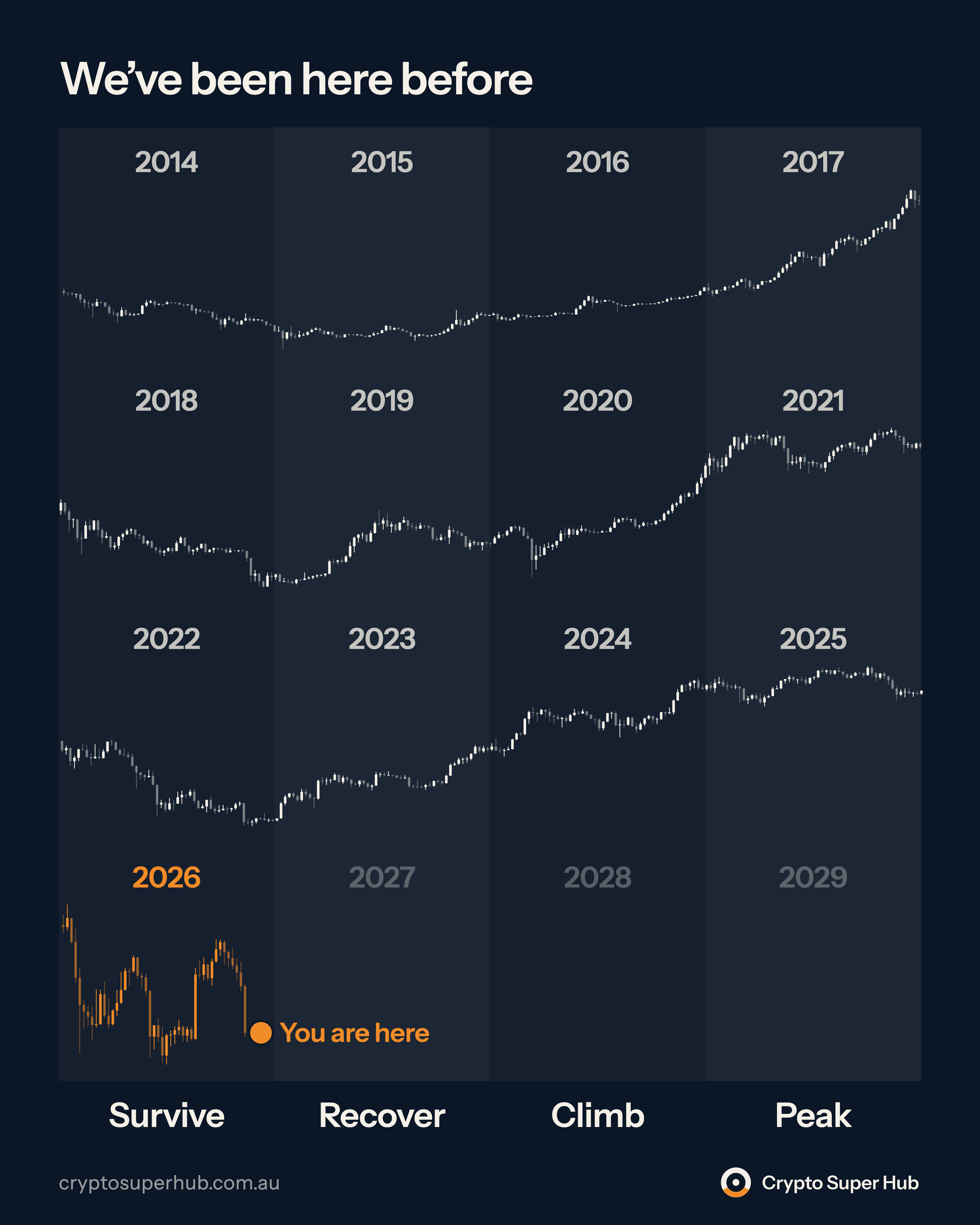
So this week I zoomed out.
New this week: the free trial no longer needs a card. More on why at the end.
The Sunday Dashboard
CSH Score: 15.7 at 3pm today, down from 25.1 last Sunday. That’s the lowest since 20 August.
Bitcoin: about US$64,800 this afternoon, after a 15.4% fall last week to Saturday’s close of US$64,114. That’s about A$95,600, roughly half its all-time high of A$189,471 in October 2025.
The 50-week moving average: about US$75,000. Monday’s weekly close (10am our time) will almost certainly be a second week under it, about 14% below.
The 200-week moving average: about US$67,600. Bitcoin is about 4% under it. It closed single weeks under it in June and August this year too.
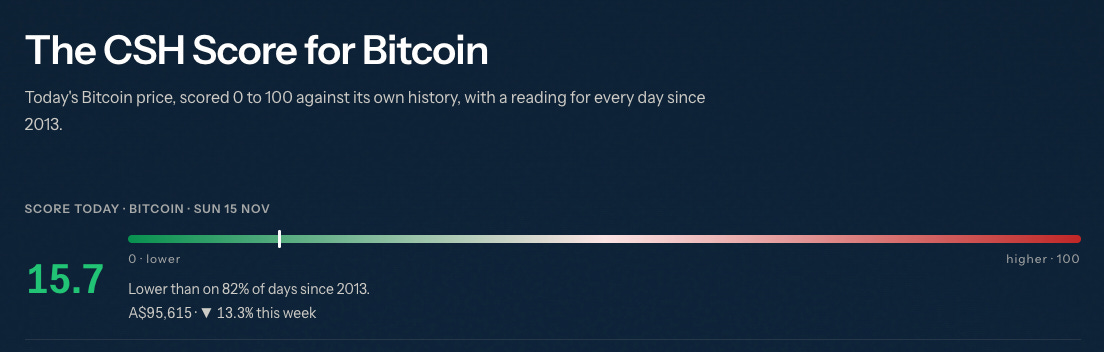
My plan buys every week the CSH Score is under 45, with bigger orders the lower it goes, so at 15.7 it’s buying. My spare cash goes in under 30, and right now any I can get my hands on is going into Bitcoin. I’m almost fully allocated, and this dip hurts. I’m setting up an SMSF bank account with NAB so I can get more Australian dollars onto an exchange and buy at these levels. My sell plan takes profit from a CSH Score of 75.
The 2026 roller coaster
Here’s how this year has felt, if you’ve been watching every candle:
May. Bitcoin’s back above US$80,000. “Time to turn bullish. Shortest bear market ever.”
June to August. It drops to US$57,800. “This can’t be the bottom. What about the four-year cycle? We haven’t even tested the realised price.”
September. It blasts through the 50-week moving average, with several weekly closes above it. “That’s confirmation. The bear market’s over, just a few months short because the last bull market never had a euphoric top.”
November. It’s back under the 50-week moving average. “Fakeout confirmed. We’re going lower.”
Since February, Bitcoin has traded between about US$57,800 and US$87,400. Every move felt like confirmation at the time. That’s how a market like this destroys traders. Very few people trade it well, and I’m not one of them.
How my calls went
I want to be completely transparent with you. I believe in being honest with my readers and taking accountability when I’m wrong. There’s way too much negativity on crypto Twitter, and too many people who never own a bad call. I’d rather be wrong and make money than be right and lose money.
So here’s my scorecard.
20 September, “Is the Bitcoin bear over? Probably.” I stopped betting on a lower low. Wrong, so far.
27 September, “It’s a bull market. Don’t blow it this time.” I said this looked like a bear market that finished early and shallow. Wrong, so far.
11 October and 25 October. I named what would change my mind: first, a weekly close under the May high; then, a weekly close under the 50-week moving average. Both happened, in that order. The May high broke on the weekly close of 19 October, the 50-week moving average on 9 November.
8 November, #40. The two times Bitcoin closed a week under the 50-week moving average with a low CSH Score, in 2019 and 2020, came after a move back above it that was a fakeout, and it took one last flush, the March 2020 crash, before the bull market started. That’s the path we’re on so far.
That’s two out of four. Not too bad, but the two I got wrong were the big ones.
One correction from #40: I said this break would come with a lower CSH Score than any of the seven before it. The week Bitcoin first closed under the 50-week, the CSH Score was 25.1. Rechecking the history this week, March 2020’s break scored 15, so ours was the second lowest of eight. It’s fallen a long way since, to 15.7 today.
I got the call wrong. The plan held up. It kept buying under a CSH Score of 45 the whole way down, and the levels that would change my mind were written down before they broke.
Zoom out: four bear markets
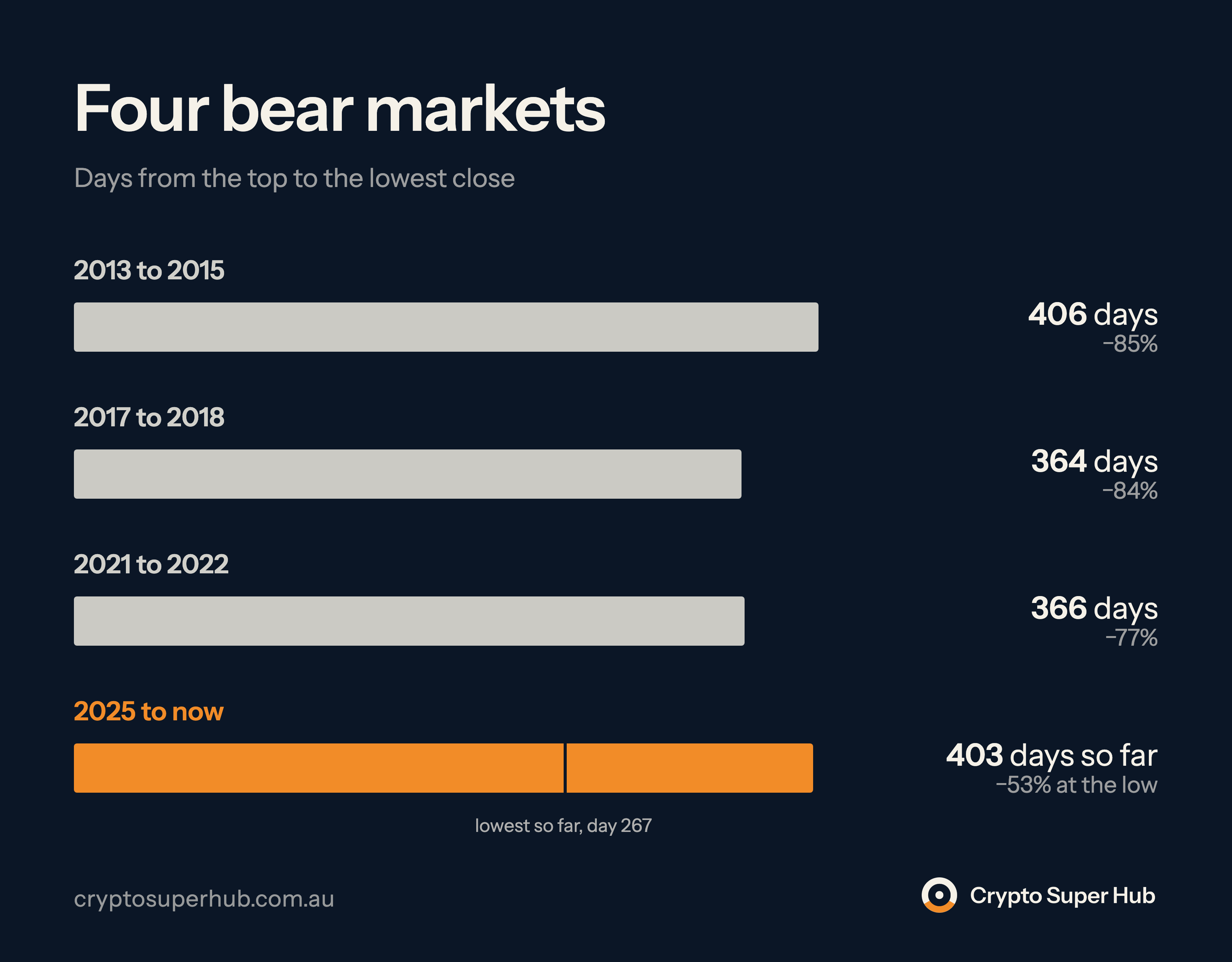
From the top to the lowest close (US$ daily closes):
2013 to 2015: 406 days, down 85%.
2017 to 2018: 364 days, down 84%.
2021 to 2022: 366 days, down 77%.
This one: 403 days since the October 2025 top of US$124,824. The lowest close so far was US$58,526 on 1 July, down 53%, 267 days in.
This bear market has already run about as long as the last three did from top to bottom. It’s also the shallowest by a long way. Tom has every crash since 2013 in Australian dollars on our Learn page: How long do Bitcoin bear markets last?
Two paths from here:
A higher low: July’s US$57,800 was the bottom. This is what happened in 2019 and 2020, and it’s the closest match I can find to this year. Bitcoin bottomed in December 2018 at about US$3,200. By June 2019 it had quadrupled to about US$12,900, back above its 50-week moving average, and plenty of people called a new bull market. Then it faded for eight months. In March 2020 the Covid crash took it to about US$5,000, 61% off the high and back under the 50-week. It felt like the bear market was back. But it stayed well above the 2018 low. That crash was the final shake-out, and less than nine months later Bitcoin passed its 2017 record.
This year has the same shape, only faster: a low in July, a 48% run back above the 50-week by September, and now a sharp fall back under it. If it plays out the same way, this week is our March 2020: a scary drop that holds above the July low.
A lower low, with the bottom in the fourth quarter of a US midterm year, like 2018 and 2022. (2014’s came a month later, in mid-January 2015.) One fact leans this way. The last three bear market lows all closed under Bitcoin’s realised price, the average price every coin last moved at: 45% under in January 2015, 30% under in December 2018 and 22% under in November 2022. This year’s July low closed 10% above it. The realised price is about US$53,700, about 17% under today’s price.
My bet is path 2: a bottom in Q4 of the midterm year, like 2018 and 2022. Whichever path we get, my plan stays the same.
Rare territory: a CSH Score under 20

In 2015 and 2016, the CSH Score was under 20 almost every day. Since 2018, it’s been that low on about one day in seven, in short bursts: around the 2018 low, the March 2020 crash, through 2022 and 2023, and this year.
Here’s the stat that keeps me calm. Since 2015, the CSH Score has closed under 20 on 1,156 days, counting only days at least three years back, so we know what came next. Pick any one of them. One year later, Bitcoin was higher. Two years later, higher. Three years later, higher. All 1,156 of them.
How much higher? A year later, the typical gain was 147%. The worst was 16%.
That’s with hindsight. But it’s why my plan’s orders are biggest when the CSH Score is this low, and why I’m rustling up spare cash to keep buying.
The next three years
Like 2014, 2018 and 2022, this is a year to survive. Look at what came after each one:
US$1,000 of Bitcoin at the end of 2014 was worth about US$41,700 at the end of 2017.
US$1,000 at the end of 2018 was worth about US$12,300 at the end of 2021.
US$1,000 at the end of 2022 was worth about US$5,330 at the end of 2025.
Each run was smaller than the last, and each one was still huge.
For me, surviving means no leverage, so nothing can liquidate me. It means buying a little every week the CSH Score is low, and a long view. And it means a plan written down before the market tries to trick me, because it will, at every single turn.
If you’ve survived this long, I think 2027, 2028 and 2029 are when we prosper.
Jake’s Workbench: two weeks free, no card
Last week, Tom and I made a hard call. We opened the 14-day free trial to everyone, with no card. Put in your email, set a password, and you get the full platform for two weeks with no commitment.
We did it for two reasons.
We want you to try all of it before you commit. We’ve built something different, and it won’t be for everyone. Things are tough in the real economy right now, so test drive it first. After two weeks, if you’re in, you become a founding member: A$19 a month for life for the first 100, then A$29. That’s less than a Netflix Standard plan, and under A$5 a week.
We’re new, and most people have never heard of us. With so many scams and bad actors out there, trust has to be earned. Tom and I have been in crypto for a combined 15 years, and we’ve seen it all. We wanted something simple and easy to use that doesn’t cost the price of a small car, and actually gives you massive value.
We built Crypto Super Hub because we wanted to invest with our heads, not our hearts. It’s kept us both sane through this market and helped us build long-term wealth for our families.
Darren, one of our first founding members, wrote this on Friday:
“I’m pretty new to BTC and I was looking for a simple metric that guided me in my BTC investing. I believe CSH is that metric. I like that I can set up several different rules based investing strategies based on the CSH score and it will trigger emails to remind me rather than me looking at the price everyday and letting my emotions get the better of me. Although I still look at the price everyday, let’s be honest.”
Shout out to Darren, he’s a legend.
Quick Hits
Nvidia’s CEO is out. Jensen Huang resigned on Thursday, effective immediately, and CFO Colette Kress is interim CEO. Nvidia gave no reason. It followed reports of affairs, including one with a businesswoman accused of being a Chinese agent, and Huang told staff he’d been unfaithful to his wife (NBC News). China denies the spy claims. Nvidia’s shares fell 12.8% for the week, and it reports results on Wednesday morning our time.
Anthropic’s IPO. The AI company has filed to list on the Nasdaq under the ticker ANT, offering 825 million shares at US$70 to US$78. CNBC reports pricing on 18 November and trading from 19 November, US time, at up to US$1.4 trillion fully diluted.
Stocks bounced, tech’s still bruised. The S&P 500 rose 2.5% last week and the Nasdaq 100 rose 3.5%, but the Nasdaq 100 is still 10.5% below its 6 October high, in correction territory.
ETF money left. US spot Bitcoin ETFs saw a net US$1.07 billion go out last week, with outflows every day (Farside Investors).
Leverage got flushed. More than US$2 billion of crypto positions were liquidated in the 24 hours to Sunday lunchtime, about 87% of them bets on prices rising (CoinGlass). CNBC pointed to a strong US dollar, institutional selling and liquidations for the fall; CoinDesk pointed to traders pricing in US rate hikes after hot inflation data, and Huang’s exit.
The Week Ahead
Mon 16 Nov, 10am: Bitcoin’s weekly close, against the 50-week moving average (about US$75,000) and the 200-week (about US$67,600).
Wed 18 Nov, 7:20am: Nvidia’s results, its first since Huang resigned.
Thu 19 Nov, 5am: the US Federal Reserve’s minutes from its October meeting.
Fri 20 Nov, from 12:30am: Anthropic’s first day of trading, if the reported timing holds.
Tue 1 Dec: Westpac’s A$10,000 monthly cap on payments to crypto exchanges starts.
(All times are Brisbane time.)
The Close
If this week rattled you, you’re not alone. It rattled me too.
Here’s what I keep coming back to. Every bear market in Bitcoin’s history felt exactly like this one does right now, and every one of them ended. The people who did best weren’t the ones who called the bottom. They were the ones still standing when it was over: no leverage, buying steadily, with a plan they wrote before the panic.
That’s what I’m doing. The CSH Score is the lowest it’s been in three months, and my plan is doing exactly what I built it to do: buying when it feels hardest.
2026 has been a tough year, but I think the next three will be worth the wait, and I’m glad you’re here for it. I’ll be in your inbox every Sunday through all of it, telling you exactly what I’m doing and why.
Hit reply and tell me how you’re handling this week. I’d love to hear from you.
Running an SMSF in Australia? If you’d like a hand, reply to this email and I’ll run you through the app.
Crypto Super Hub is general information and education only. Nothing here is financial advice, and it doesn’t take your objectives, financial situation or needs into account. Crypto is volatile and you can lose money. Past performance doesn’t guarantee future results. Do your own research and consider speaking with a licensed financial adviser before making investment decisions. We hold Bitcoin ourselves, so assume we’re biased.