


In December 2021 I was less than a year into crypto and sitting on the biggest gains of my life. FTM, LUNA, a handful of alts I’d been early to. I remember the exact thought: that’s a tidy profit, maybe I should sell some. And then the other one: we’re going higher. So I held. Some of it was locked in staking pools, so in 2022 when I finally wanted out, I couldn’t. I rode the whole thing back down. Tuition fees, I call it now. I’ve got the scars to prove it.
Everyone I talk to this year is trying to buy the low. Is it in, will it dip further, should I go all in now. Nobody asks when to sell. I didn’t either, and that’s the question that actually cost me.
So this week I tested it. I took the CSH Score history, every day of Bitcoin since 2012, and ran three hypothetical investors through it, each putting A$500 a week into Bitcoin from January 2017. Nearly ten years, three bull markets, three bears. One never sells. One panics and sells, then buys back late, the way most people actually behave. One follows a written rule. The rule finished with 74% more Bitcoin and A$1.6 million more than never selling. It’s below, and the version I’d run this cycle is at the end.
CSH Risk Dashboard
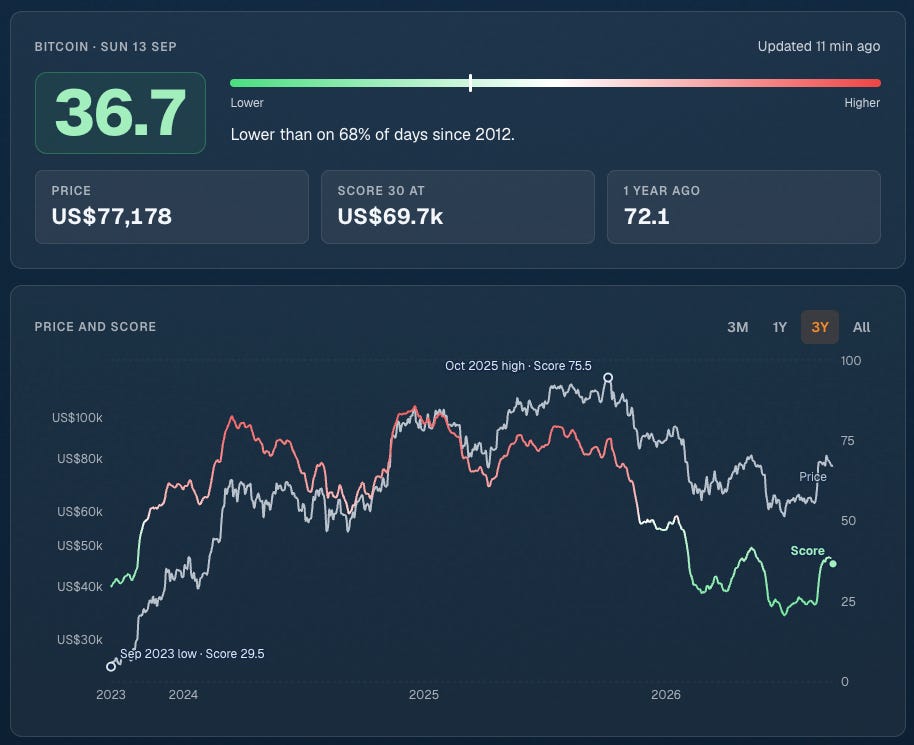
CSH Score closed the week at 36.8, down from last Sunday. Lower than on 68% of days since 2012.
Bitcoin: US$77,303 in our history on Sunday, about A$107,800. Last Monday’s weekly candle closed at US$80,339, right on the 50-week moving average, and this week it’s trading back under it. The 50-week MA sits at about US$79,600 (TradingView, Bitstamp weekly, 13 Sep).
Support below: the bull market support band, roughly US$70,100 to US$71,800 on the same chart, and a CSH Score of 30 is about US$69.7k today. Those two levels are stacked on top of each other.
Golden cross, two weeks on: I said the first month after one is usually a sell-off and the year after is usually up. The sell-off part arrived on schedule.
My plan: waiting. It buys between 10 and 30. It stopped on 22 August when the Score crossed 30 and it hasn’t placed an order since.
What the reading changes: nothing, yet. Bitcoin is being squeezed between the 50-week MA above and the support band below. Rejections off the 50-week MA in past cycles tended to happen fast, within a few weeks, so the longer we hang around just under it, the better I like it. The signal I’m waiting on to call the bear finished is consecutive weekly closes above the 50-week MA. Yes, waiting for that means missing part of the move. That is the exact reason a plan buys the lows on a schedule instead of on a feeling.
Three investors, one rule
Here’s the set-up. Three hypothetical investors, each putting A$500 into Bitcoin every Monday from 2 January 2017 to now. That’s 506 weeks and A$253,000 each.
The first never sells (HODL). A$500 in, every Monday, no exceptions.
The second does what most people actually do. Buys every week, panic-sells everything after a 50% fall, and buys back once the CSH Score is over 60 again, when it feels safe.
The third follows a written rule. Buys from the reserve while the CSH Score is under 35, larger buys the lower it goes. Sells 10% of the Bitcoin held every week the Score is 80 or higher, 20% above 90. The money from the sales sits in the reserve for the next time the Score is under 35.
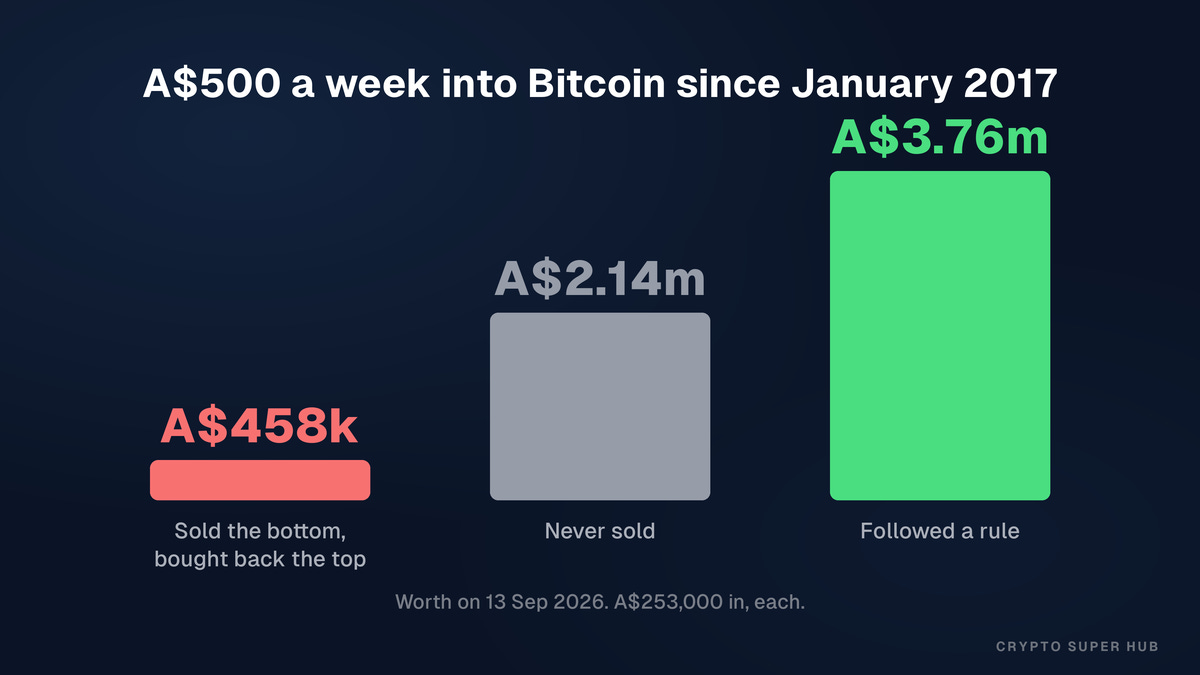
Never sold: 19.87 BTC, worth A$2.14 million. Eight and a half times the money in, after a 77% fall along the way.
Sold the bottom, bought back the top: no Bitcoin, A$458,000 in cash. Less than double the money in. Four round trips: sold at A$10k in early 2018, bought back at A$13k, sold at A$6k, bought back at A$12k, sold at A$43k in May 2022, bought back at A$67k, sold at A$93k this March. I want to be clear that every one of those moves felt sensible on the day. That’s what makes it the most common path.
Followed the rule: 34.56 BTC plus A$35,000 in cash, worth A$3.76 million. Nearly fifteen times the money in. Worst fall 37%.
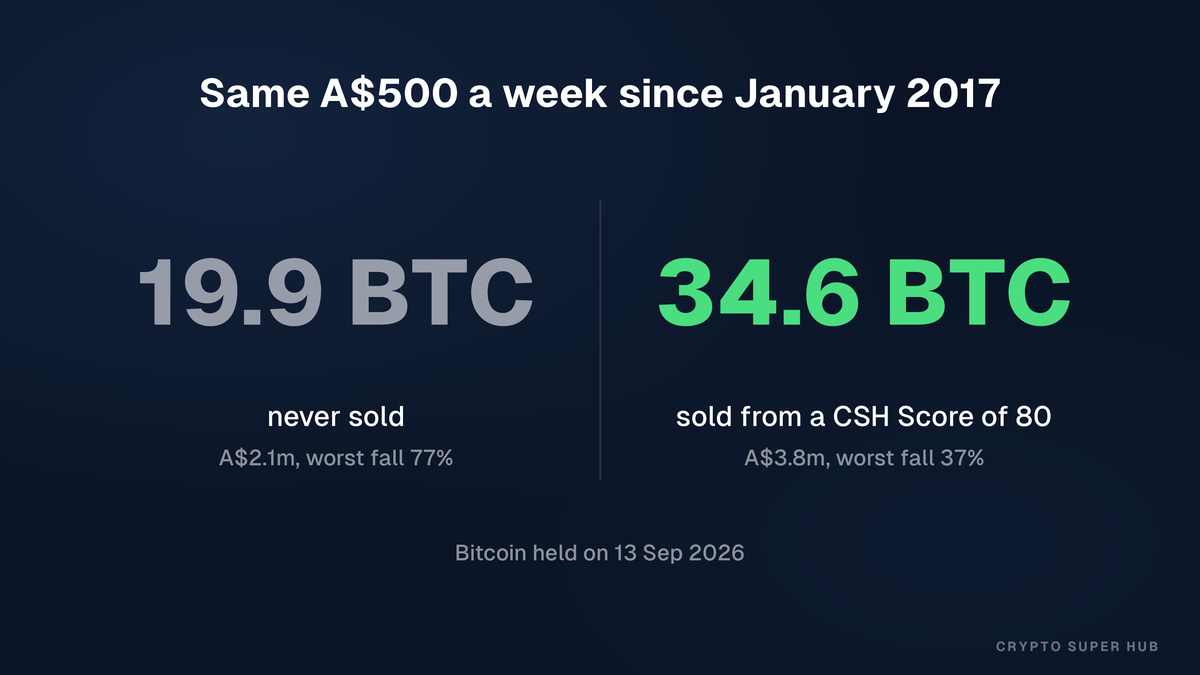
Seventy-four per cent more Bitcoin than never selling. A$1.6 million more. Half the drawdown. Same money in.
What the rule actually did, and when it looked wrong
It sold 42 times, A$3.3 million worth, at an average of A$105,000. Twenty-eight of those sales were in 2021 at an average of A$57,000. Nine were between March and December 2024 at an average of A$133,000. Four were in January and February 2025 at an average of A$160,000. Then it stopped, because the CSH Score never got back to 80. The October 2025 top scored 75.5.
So the rule sold a year early and well under the top. At the top it was holding a third as much Bitcoin as the never-seller and A$2.6 million in cash, watching the price run to A$190,000 without it. For most of 2025 the rule looked like the wrong call, and if I’d been running it I’d have copped it in the replies.
Then the Score fell under 35 in February this year and the rule bought back, 23 Mondays at an average of A$96,000. Add the 2022 buys at an average of A$30,000 and it bought A$3.4 million worth of Bitcoin back at an average of A$65,000. Sold at 105, bought at 65. That gap is the extra Bitcoin.
This is the thing about a working exit rule. It sells while everyone’s still bullish, it looks stupid for a while, and it’s right over the whole cycle. In 2021 I had nothing to follow, so I followed the little voice instead.
Even from the worst week to start
Run the same three investors from the Monday after the November 2021 top. Never selling ends with 2.02 BTC. The rule ends with 2.65 BTC, 31% more, and its worst fall was 23% instead of 50%. At the October 2025 top the never-seller was ahead by A$69,000. Eleven months later he isn’t.
Jake’s Workbench
Two things from the model this week.
One. I asked for the whole grid: buy under 25, 30, 35 or 40, sell from 60 through 90, 5% to 25% a week. Buying under 35 beat buying under 30 from every start date. Under 30 spends too long waiting; only 22 days of 2023 scored under 30. My plan buys between 10 and 30. The history says I’m a touch too strict, and I haven’t changed it yet. Selling from 75 and from 80 tied; from 70 was slightly behind. The exact number barely matters. Having one is what matters.
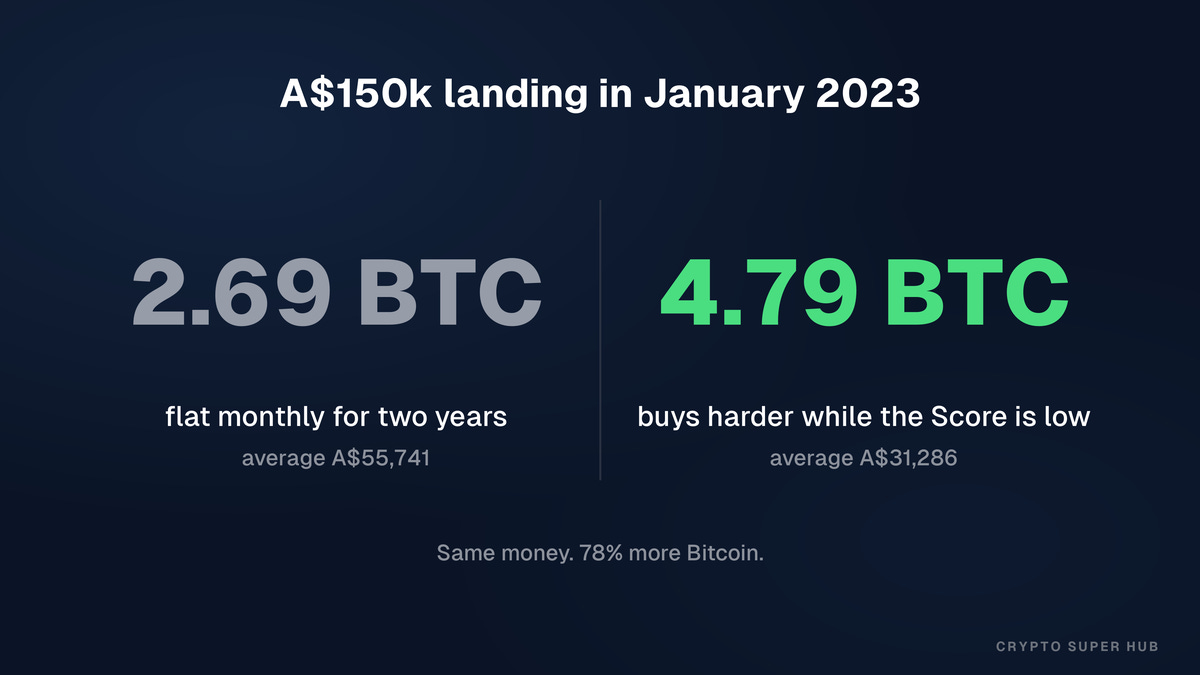
Two. My SMSF made its first Bitcoin buy in January 2023, with the CSH Score at 15. So I modelled a fund starting then with a hypothetical A$150,000 rollover. Bought on a flat monthly schedule over two years, it ends up with 2.69 BTC, worth about A$290,000 today. The same A$150,000 on a plan that buys harder while the Score is low ends up with 4.79 BTC, worth about A$517,000. Seventy-eight per cent more Bitcoin from the same cash, and the fund is three and a half times its starting size in under four years. My own buying in 2023 was messier than either of those, and I bought cautiously into the cheapest Bitcoin of the decade. Caution was the expensive option.
Product note: the app’s Today page was rebuilt this week. Your plan’s buy range drawn on the Score, each plan in one sentence with the next order in large type, and your record of orders against the Score on one chart. More on that once it settles.
Quick Hits
The US Fed decides rates on Thursday at 4am our time. After Friday’s US inflation print, markets are pricing a rate rise, not a cut, at close to 90% (CME FedWatch via CBS News, 11 Sep). My plan has no Fed input. It has a Score range.
The US Senate votes on Wednesday at 4:15am our time on whether to even proceed with the CLARITY Act, the crypto market structure bill. It needs 60 votes. Prediction markets had it under 20% a week ago.
The RBA meets on Tuesday 29 September. Futures were pricing about an 80% chance of a rise as of 7 September.
From 1 July 2027 the 50% CGT discount is replaced for individuals, trusts and partnerships by cost-base indexation and a 30% minimum tax on gains. It passed in June. The change doesn’t name super funds; the ATO’s SMSF page still shows the one-third discount. If your exit plan runs into 2027, this belongs in the conversation with your accountant.
Mt Gox’s creditor repayment deadline is 31 October. It’s a deadline, not a scheduled sale.
Week Ahead
Two levels and one date. Above: the 50-week MA at about US$79,600. Consecutive weekly closes above it and I flip bull in public. Below: the support band and a Score of 30, stacked around US$70k. If the Score comes back under 30, my plan starts buying again on the Monday and I’ll tell you the size. The date is Thursday 4am, the Fed. Whatever it does, the plan’s answer is the same as it was on Monday.
The Close
Here’s the playbook for this cycle, as plainly as I can put it. Buy on a schedule while Bitcoin is historically cheap, meaning a CSH Score under 30 to 35. Stop when it isn’t. Sell a slice a week while it’s historically expensive, meaning a Score of 75 to 80 and up. Keep the proceeds for the next time it’s cheap. Write all of it down before you need it, because you will not be able to think straight when the Score hits 85 and your portfolio is up four times.
Livermore said it a hundred years ago: be right and sit tight. Sitting tight is easy when you’ve already written down what you’ll do.
If you want to write yours down, the whole app is free for two weeks: the live CSH Score, the Plan Builder and your record against the Score.
Crypto Super Hub is general information and education only. Nothing here is financial advice, and it doesn’t take your objectives, financial situation or needs into account. Crypto is volatile and you can lose money. Past performance doesn’t guarantee future results. Do your own research and consider speaking with a licensed financial adviser before making investment decisions. We hold Bitcoin ourselves, so assume we’re biased.
Weekly Cycle high (right now).
Buy it again end of October.