

Crypto Super Hub — Weekly Market Intelligence | Apr 12, 2026
I just finished Morgan Housel’s The Psychology of Money. It’s one of those books that makes you feel smart and stupid at the same time. Smart because the ideas click instantly. Stupid because you realise you’ve broken every single rule he lays out.
Here’s the line that stuck: “The hardest financial skill is getting the goalpost to stop moving.”
That’s crypto in one sentence. You hit 2x and want 5x. You hit 5x and hold for 10x. Then you ride it back down to where you started, wondering what happened. I did exactly this in 2021. Sat on a 300% gain across three altcoins, told myself the cycle had more room. Watched every dollar disappear over the next six months.
The problem was never the market. The problem was my brain. And if you’ve been in crypto for more than one cycle, I’d bet money your brain has cost you more than any rug pull, hack, or exchange collapse.
That’s what I want to break down this week. Not the charts. Not the macro. The five psychological traps that cost crypto investors the most money, and what I’ve built to try to remove them.
CSH Risk Dashboard
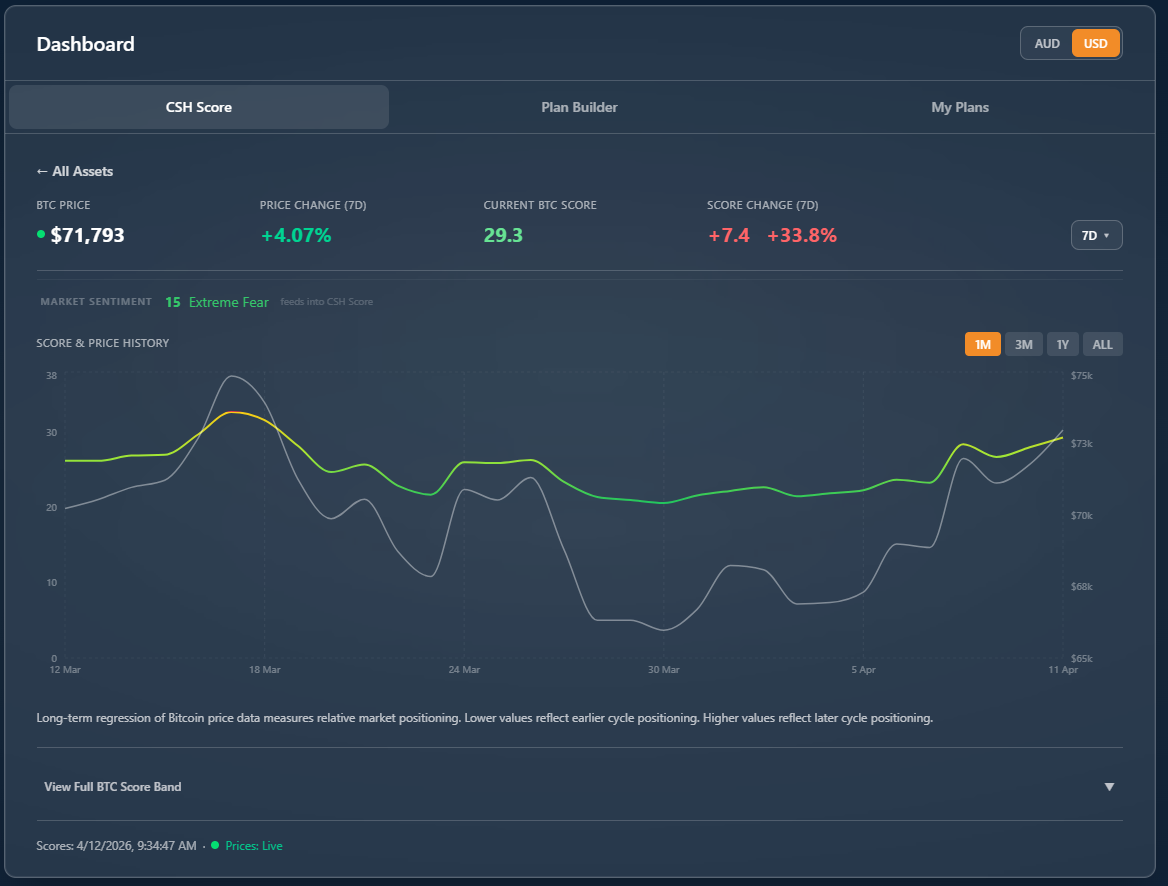
CSH Score: 29.3 / 100 | Accumulation Zone | Direction: Up (+7.4 points, +33.8% over 7 days)
BTC Price: US$71,638 (+4.58% 7d) Market Sentiment: 15. Extreme Fear. Score last week: 21.9
Last week I said I was still buying at $67K. BTC bounced. The Iran ceasefire announcement on April 7th sent price above $72K. The S&P ripped higher. Oil dropped below $96. Risk assets across the board caught a bid. The CSH Score jumped from 21.9 to 29.3 in a single week. That’s the biggest weekly move since we launched the score.
Here’s where the psychology kicks in. Two weeks ago, with sentiment at 8, almost nobody wanted to buy. Now BTC is up 4.58% on the week, equities are surging, and people are suddenly feeling confident again. The price moved. The fundamentals didn’t change. Your brain did. Sentiment is still at 15. Still Extreme Fear. But it doesn’t feel like Extreme Fear anymore, does it? That gap between what the data says and what your gut says is the entire point of this week’s newsletter.
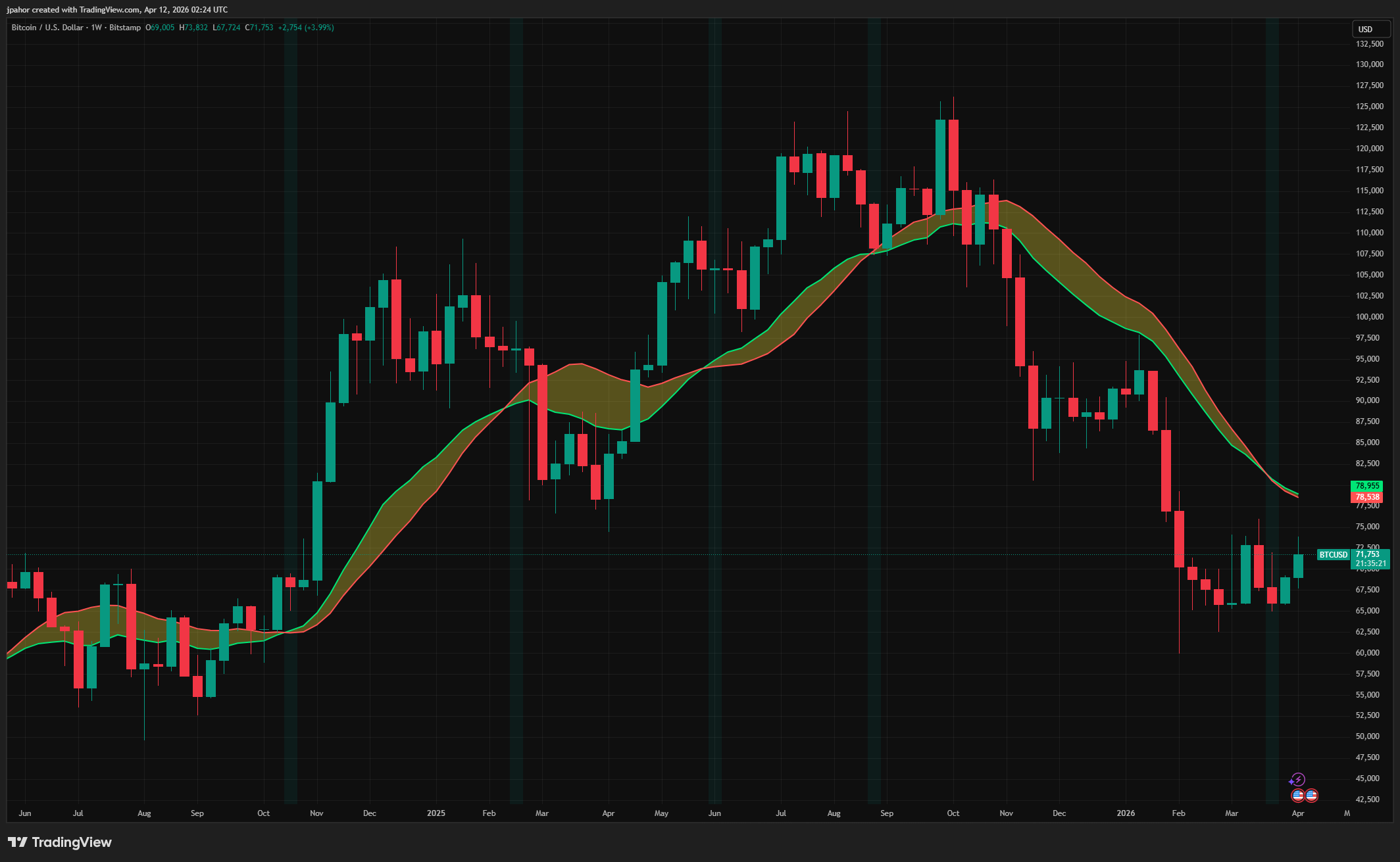
The bounce is real but there’s resistance ahead. BTC is trading below the bull market support band. The 21-week EMA sits at $78,533 and the 20-week SMA at $78,947. That’s roughly 10% above current price. Until BTC reclaims that band, this is a bear market rally, not a trend reversal. We saw the exact same pattern in March when BTC ran from $60K to $74K before rolling over.
BTC dominance is holding at 59.55%. Capital continues flowing into BTC and away from alts. The TOTAL3/BTC ratio is at 0.36, still making lower lows. The alt rotation isn’t here yet.
Seasonality isn’t helping either. “Sell in May and go away” applies to crypto too. BTC’s average returns from June through September are significantly weaker than the rest of the year. And 2026 is a US midterm year, which are historically the most challenging for risk assets. Data going back over a decade shows BTC tends to experience a price decline from April through early June, with short positions prevailing 80-100% of the time over 3 and 5-year samples.
None of this means sell everything. It means manage your expectations about what a bounce at $71K actually represents. The system reads the score, not the vibes.
The Psychology of Crypto
Morgan Housel wrote about money. But swap “money” for “crypto” and every lesson hits harder. Because crypto takes every psychological bias you have and amplifies it with 24/7 markets, 80% drawdowns, and a culture that rewards conviction over caution.
Here are the five traps that cost people the most.
The moving goalpost.
Housel’s central insight: people who have enough but don’t feel like it end up taking risks that cost them everything they’ve already gained. In crypto this plays out every single cycle. You’re up 3x on your BTC position. You could take profits. Instead you hold because someone on Twitter is calling for $500K. Then you watch the drawdown eat your gains because you never defined what “enough” looked like before the run started.
I did this with my altcoin portfolio in 2021. Up 300% across three positions. My exit target? I didn’t have one. The CSH Plan Builder exists because of this exact mistake. You set your distribution plan before the euphoria hits. Score above 70, start scaling out. Not because you’re smart. Because you decided in advance.
Confusing luck with skill.
Housel calls this one of the most dangerous things in investing. You buy SOL at $8, it runs to $260, and you think you’re a genius. You weren’t. You were early and lucky. The problem is that the “genius” then sizes up their next bet based on a track record that was mostly timing.
I watched this happen to myself and dozens of people around me in 2021. Everyone was a crypto expert in a bull market. The people who survived the 2022 bear were the ones who admitted they’d been lucky and built systems for the next cycle. The ones who thought they had skill? They doubled down on the next narrative rotation and got crushed.
The tail events trap.
Housel points out that a tiny number of events drive the majority of outcomes. In crypto, this is extreme. Your portfolio return over a five-year period is probably determined by what you did during three or four weeks of extreme fear or extreme greed. The rest is noise.
The Fear & Greed Index hit 8 two weeks ago. That’s a reading we’ve seen fewer than ten times since the index launched. Every previous sub-10 reading has delivered strong returns over the following 90 days. But here’s the thing. Knowing that fact is easy. Actually buying when the number is 8 and everyone around you is panicking? That’s the hard part. That’s why the CSH Score exists. It doesn’t eliminate fear. It gives you a pre-committed framework so you don’t have to make decisions in the moment. The score jumped 33.8% this week. It didn’t ask how you were feeling first.
Wealth is what you don’t see.
This is Housel’s most counterintuitive idea. Real wealth isn’t the Lambo. It’s the money you didn’t spend. Applied to crypto: the best investors I know are the ones whose portfolios look boring. Monthly DCA into BTC. No leverage. No 50x futures plays. No one is making content about their strategy because there’s nothing flashy to show.
My best performing crypto asset after 5+ years in the market? The BTC I started DCA-ing into my SMSF in early 2023. Monthly recurring buy. Set and forget. Even after a 50% drawdown from the all-time high, I’m still up significantly. Nobody on Twitter would retweet that. But it’s the position that actually built wealth.
Room for error is the most underrated concept in investing.
Housel writes that planning for things to go wrong isn’t pessimism, it’s realism. In crypto, this means never putting yourself in a position where a 50% drawdown wipes you out. Never allocating so much that you’re checking prices at 2am because you can’t sleep.
The CSH Score at 29.3 right now with a bounce to $71K feels good. But the system is designed with room for error built in. It assumes the score could drop back below 20. It assumes BTC could retest $60K. The bull market support band at $78-79K is still 10% overhead. The accumulation framework doesn’t need the bottom to be in. It just needs you to still be in the game when the bottom eventually arrives.
The common thread? Every one of these traps is a brain problem, not a market problem. The market does what it does. Your job is to have a system that makes the decisions before your psychology kicks in. That’s what the CSH Score, Plan Builder, and My Plans are for. Not to predict the future. To protect you from yourself.
Jake’s Workbench
I’ve been building something boring and it might be the most useful thing I’ve done all year.
A portfolio dashboard. One screen that shows my total crypto allocation, SMSF balance, exchange balances, DCA budget remaining for the month, and how it all fits against my overall financial plan.
Before this, I was updating a massive spreadsheet once a month. It took hours. By the time I finished, half the numbers were already stale. I used Claude to build a live, automated version that pulls everything into one view. What used to be a painful monthly chore now updates itself. Better visibility, better analytics, zero manual data entry.
Housel talks about this. The people who build wealth aren’t the ones with the best stock picks. They’re the ones who understand their entire financial position and make decisions from that context. “Know your numbers” sounds obvious until you realise most people in crypto couldn’t tell you within 20% how much of their net worth is in digital assets.
Now when the CSH Score drops and the system says accumulate, I can see exactly how much room I have to deploy without overextending. That’s the psychology of money in practice. Not exciting. Just useful. And it took one weekend with AI to replace a process I’d been dreading every month for two years.
Quick Hits
Iran ceasefire triggered a relief rally but it’s already fracturing. Trump announced a two-week ceasefire on April 7th (US time). Markets surged. BTC jumped from $68K to above $72K. Oil dropped. But the reality on the ground is messier. Israel launched massive strikes on Lebanon hours after the deal, killing 254+ people. Iran paused Hormuz traffic in response. By April 9, the Strait was still effectively closed. Vance led 21 hours of talks in Islamabad on April 11 and came out with no agreement. US Navy destroyers have entered the Strait for “mine clearance.” Oil is climbing back, sitting at $95.62. So what: the market priced in peace. It hasn’t arrived. If the ceasefire collapses fully, expect oil back above $100 and a sharp risk-off reversal. The system doesn’t trade headlines. It reads the score.
Bitfinex margin longs at a 2-year high. Leveraged long positions on Bitfinex hit 80,057 BTC, the highest level in over two years. Historically, elevated margin longs have acted as a contrarian indicator. They build during stress and decline as prices strengthen. So what: a lot of traders are betting on a continued bounce. When the trade gets crowded, it tends to unwind painfully. Risk management matters more than conviction right now.
BTC dominance at 59.55% and holding strong. Capital continues flowing into BTC and away from alts. ETH is down 2.88% on the day, SOL down 3.11%, while BTC holds at -1.94%. The TOTAL3/BTC ratio sits at 0.36. Everything is bleeding harder than BTC. So what: the altcoin trap thesis from Issue #7 is still playing out. If you’re holding alts hoping for a rotation, the data says patience. BTC remains the accumulation priority.
The Week Ahead
BTC is sitting at $71,638 after the ceasefire bounce. The bull market support band (21w EMA $78,533, 20w SMA $78,947) is the first major resistance overhead. A sustained move above $75K would be encouraging. A rejection and roll back below $68K reopens the $60K conversation.
“Sell in May” seasonality is approaching. The next 4-6 weeks historically represent one of BTC’s weakest seasonal windows. The equities surge this week was impressive, but the VIX at 19.23 is still elevated. The DXY dropping below 99 is a tailwind for risk assets, but don’t mistake a bounce for a trend change. If you’re sitting on gains from the rally and feeling good about it, that’s exactly when the psychology of money matters most. The goalpost just moved. Don’t chase it.
Powell’s term as Fed Chair ends May 15. Trump nominated Kevin Warsh as his replacement back in January, but the Senate confirmation hearing originally set for April 16 has been delayed. Warsh hasn’t submitted his financial paperwork yet, and Senator Tillis is blocking all Fed nominations until a DOJ probe into Powell is dropped. April 21 is the earliest possible hearing date. If Warsh isn’t confirmed by May 15, Powell has said he’d serve as chair “pro tem.” The uncertainty around Fed leadership is another reason to let the system make your allocation decisions, not your gut.
The Close
Housel wrote that “doing well with money has little to do with how smart you are and a lot to do with how you behave.”
Replace “money” with “crypto” and nothing changes.
The CSH system isn’t built for smart people. It’s built for humans. Humans who panic when sentiment hits 8 and get overconfident when the score bounces 33% in a week. Humans who hold for 10x when they should have taken 3x. Humans who check prices at 2am and make decisions they regret by morning.
The system doesn’t fix the market. It fixes the behaviour.
Jake
Reply with the trap that’s cost you the most. Just the number (1-5). I’ll share what everyone said next week.
#2 Took longer than it should have to realize.