

Crypto Super Hub — Weekly Market Intelligence | 24 May 2026
A client messaged me on the weekend. He runs an SMSF, he’s exactly the sort of person I write this for, and watching close to two grand vanish from his Bitcoin in a couple of days had killed any urge to buy more.
I get it. The phones at work have gone quiet again. That rush we saw when Bitcoin was pushing past $80,000 has drained away, and what’s left in the customer base right now is mostly fear. Bitcoin is a volatile asset. It isn’t for everyone, and anyone who tells you the lows feel good has never sat through one.
Here’s the thing, though. I haven’t added to my own Bitcoin since February, and the reason isn’t fear. It’s closer to the opposite. I’ll come back to that.
This week, two things. First, where the Score actually says we are, and how that stacks up against the last two bears, because the real picture is calmer than the panic around it. Second, the SMSF questions that filled my inbox after last week, because plenty of you already have one foot in this and want to know how it really works.
Let’s get into it.
CSH Risk Dashboard
Score: 32.8. Price: $76,646. Fear and Greed: 28 (Fear).
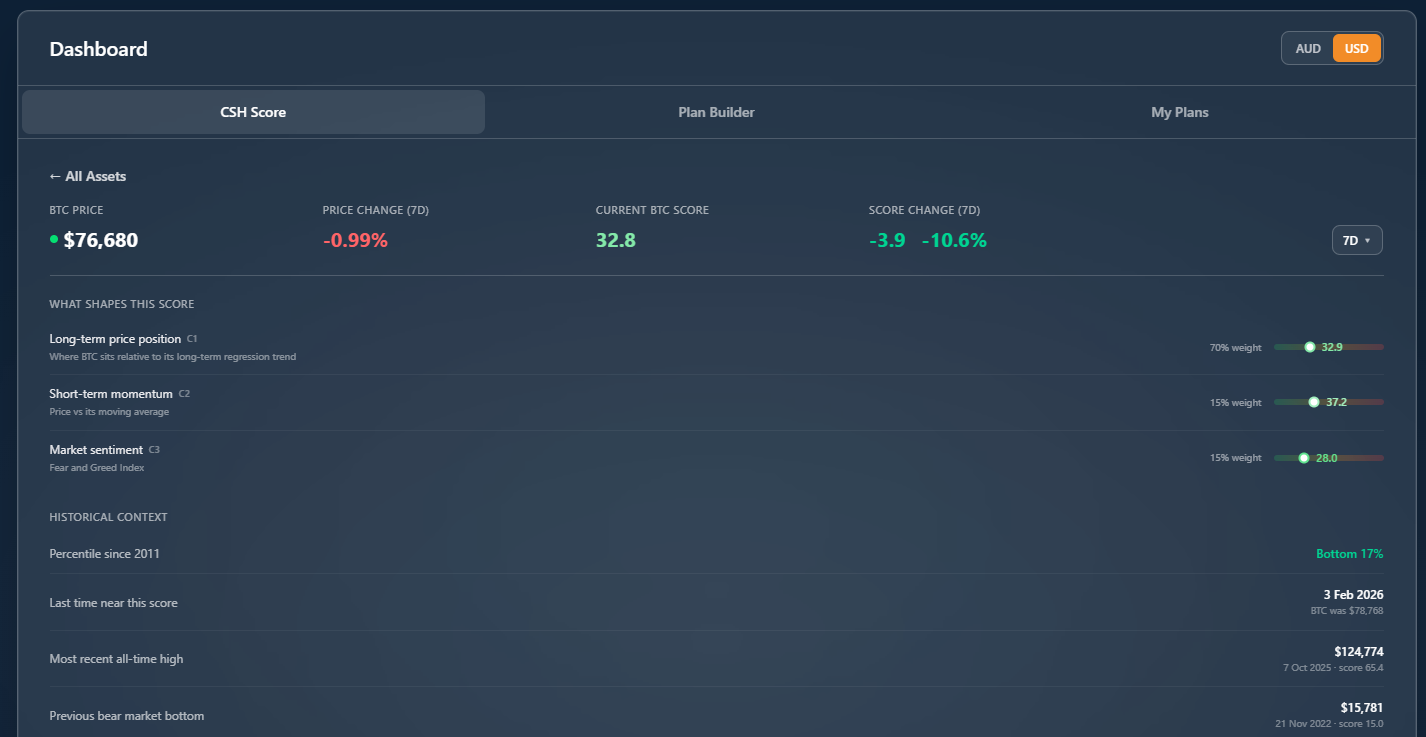
Here’s the detail worth pausing on. Price barely moved this week, down less than 1%, yet the Score still dropped about 10% (down 3.9 points). That gap tells you the weakness is under the surface: a flat price slipping further behind a long-term trend that keeps grinding higher, with momentum and sentiment both softening underneath it.
Rewind to February, though, and the bigger picture is the one that matters. We were in the depths of the capitulation back then, a Score of 18.9 with Bitcoin briefly on a $62,853 handle. We bounced hard off that low, ran straight into resistance, and we’re now handing some of the bounce back. We are not at the lows.
In plain English: the model puts fair value at $131,532, and we’re trading a long way beneath it. The floor sits at $47,322, the ceiling at $168,129. At 32.8 we’re in the bottom 17% of every reading since 2011, which has historically been an accumulation zone, not a panic one.
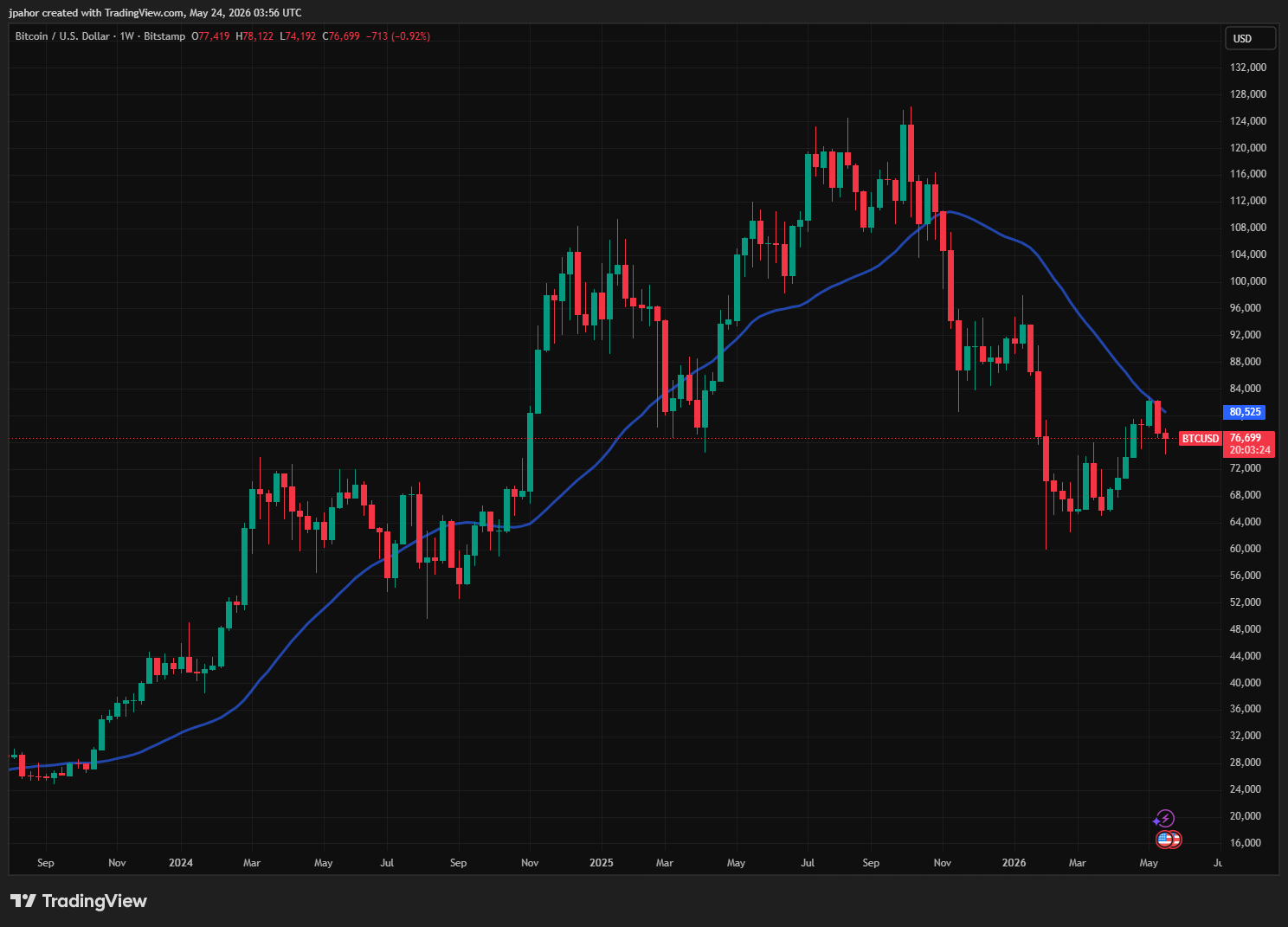
What changed this week is momentum, not the structure underneath. The bounce stalled around $82,000, right at the 200-day moving average, and buyers couldn’t reclaim it. That line is the divide between “deep correction” and “back in the game.” Until price clears it, the path of least resistance is sideways to lower, and the Score agrees: low 30s and drifting, not basing yet.
The SMSF Questions You Actually Asked
Last week’s piece on the Budget’s CGT changes lit up my inbox more than anything I’ve written in a while. Almost all of it came down to one question: “alright, how do I actually do this?”
Before I answer, the part only I can tell you.
I set up my SMSF at the end of 2022 and started buying Bitcoin inside it in early 2023. Best financial decision I’ve made, full stop. The reasoning was simple. Like most Australians, nearly all my wealth sat in two places: a house and my super. The house I can’t do much with. My super I couldn’t point at the assets I had the most conviction in, Bitcoin and crypto, because a standard retail fund just doesn’t let you. An SMSF was the only door into that.
Here’s the part I find funny now. I ran it past a financial adviser first, and they told me not to. They quoted the usual line, that you want a balance of around $500,000 before an SMSF makes sense on cost, which for me back then would have taken decades. That number isn’t plucked from thin air. It’s a real cost consideration, and ASIC has pointed to it. It just didn’t fit my situation, or my conviction that Bitcoin was badly underpriced coming out of the 2022 bear. So I backed myself. I was rewarded with entries in the $20,000 to $30,000 range, and my only regret is not buying more.
That’s my story, not your instruction. Your situation is yours, and a licensed adviser and a good accountant are exactly who should pressure-test it. But you should at least know which questions to ask, because the internet is full of confident wrong answers. Here are the ones I keep getting.
“Can I move my existing Bitcoin into the fund and skip the CGT?”
No. Moving coins you already hold into your SMSF counts as a sale at market value, so it triggers the tax rather than dodging it. On top of that, the rules generally don’t let your fund acquire assets from you in the first place. The clean path is the simple one: the fund buys its own Bitcoin, with its own money, from here. The tax advantage is for what you build inside the fund, not a back door for the stack you already own.
“Do I have to hand my coins to someone else, or can I hold them myself?”
You’ve got options. Your SMSF’s Bitcoin can sit in your own cold storage wallet, completely compliantly, which surprises a lot of people. Or you can hold it with a compliant exchange. I work at one, Coinstash, so weigh that how you like, but the criteria are what actually matter: Australian, licensed, one-to-one asset backing, and independently audited. Either way, the rules don’t change. The coins have to be held in the fund’s name, kept entirely separate from anything you own personally, valued in Australian dollars at 30 June each year, and documented well enough to pass the annual audit. Self-custody is allowed. Sloppy self-custody is how you fail that audit, and that’s exactly where a good accountant earns their fee.
“How long does it take, and what’s the holdup?”
It varies, and you’ll hear very different numbers. In my experience, with a good accountant handling the paperwork, it’s weeks rather than months. I’ve also heard people quote around six months and a couple of grand to set up. The holdup is almost never the crypto. It’s picking the right accountant and getting the trust deed and investment strategy done properly. The costs come out of the fund, and if your strategy is simple, buy and hold, the ongoing fees stay low.
“I can’t touch it for decades, and what if the government changes the rules?”
Fair, and worth taking seriously. Super is preserved, so you generally can’t access it until you reach preservation age, now 60 for most people, and meet a condition of release. And yes, rules can change. But two things. You almost certainly already have super, because your employer is required to pay 12% of your wage into it every year, money that’s sitting there whether you think about it or not. So the real question isn’t “super or Bitcoin.” It’s whether you want a say in what your existing super holds, or you’re happy leaving it in a retail fund clipping fees for a single-digit return. As for the rules changing, that’s true of nearly everything. It’s a reason to stay informed, not a reason to freeze.
And one more thing, because the Budget just proved the point. Last week’s changes scrapped the 50% CGT discount for individuals and replaced it with cost-base indexation plus a 30% minimum tax on real gains from 2027. They left super alone. So inside an accumulation-phase SMSF you’re still looking at roughly 10% on long-held gains, and 0% once the fund is in pension phase, while holding personally just got more expensive. The gap between the two didn’t shrink. It widened. For most Australians building wealth for the long haul, it’s hard to name a more tax-effective structure in the country right now.
To be clear about my own setup, the SMSF is my long-term safety net, not the whole plan. I’m also building for now, a business and personal Bitcoin, because I want options well before I’m 60. Both, not either.
The CSH Score reads the same whether your Bitcoin is personal or in super. Same data, same signals, different tax outcome. Create your free account and run your own numbers.
Jake’s Workbench: Same Rhythm, Shallower Cycle
So, why haven’t I bought since February?
It isn’t fear, and it isn’t a timing hunch. It’s the system doing exactly what it was built to do. When the Score dropped below 20 in February and Bitcoin had a $62,000 handle, that was the Ladder screaming its loudest, and that’s when I backed up the truck. The Ladder buys harder the lower the Score goes. It doesn’t buy the same amount every week under 40. The deepest fear gets the biggest buys, that reading came in February, and I acted on it.
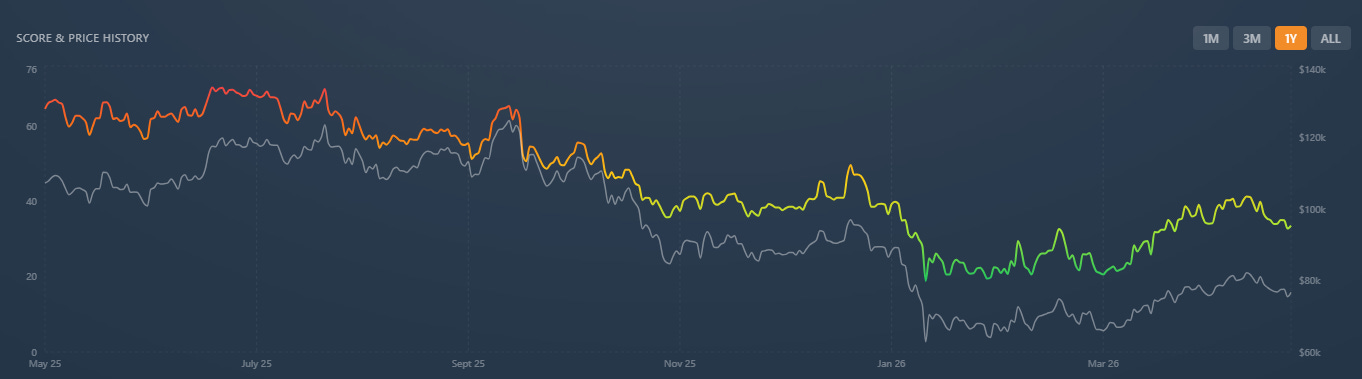
At a Score of 33, after a 30% bounce, with the 200-day rejecting us and momentum rolling over, the system isn’t telling me to empty the clip. It’s telling me to keep some dry powder for the readings that pay the most. My base case, and I’ll happily be wrong, is that we test the $60,000s again and probably go lower into the back half of the year. If that plays out and the Score prints deep fear a second time, that’s when I get aggressive again. If history rhymes, the bottom likely lands in Q4, and Q4 bottoms tend to be the entries you talk about for years.
And to head off the obvious question: no, I haven’t gone off dollar-cost averaging. A simple, regular buy is still the best thing most people can do, and if that’s you, keep going, it beats trying to pick the exact top and bottom every time. What I run is the dynamic version of the same habit, sized to the Score. Lean in hard when fear is on the floor, ease off after a bounce like this one. Right now we’ve bounced, so I’ve eased off. Same discipline, different dial setting.
So why call it a shallower cycle when the chart looks so familiar? Because the shape and the depth are two different things.
The shape rhymes, no argument there. Bears move to a rhythm: a sharp drop, a consolidation, a counter-trend rally that drags everyone back in, then another leg down. We just lived the rally-into-lower-high part. Bitcoin did the same in 2022, running to nearly $47,000 in late March before getting rejected and bleeding to under $20,000 by June. It did it in 2018 too, when every bounce failed and the market ground all the way down to $3,200.
The depth is where the doom takes fall apart. This top was never euphoric. The Score peaked at 65.4 last October, against 85 at the 2021 top and 91 back in 2017. We never got the blow-off, the leverage, the taxi-driver mania that powered those monster crashes. And the crashes matched the mania: down 77% in 2022, down 84% in 2018. This time, at the worst of it, we’re down about 50% from the October high, and the model’s floor is $47,322, not a number with one fewer digit. The sequence rhymes. The depth probably won’t, because we never paid for it on the way up.
I’m not the only one landing here, either. Ben Cowen’s latest macro memo reaches a similar place from completely different ground, reading the US economy rather than the crypto charts. His point is that midterm years like 2018 and 2022 tend to see weakness early, then a stabilisation, then the more serious leg later in the year, once tight policy and high yields have had time to bite. He flags Q3 and Q4 as the window to watch, and he’s clear that none of it is an imminent, this-week event. Two models, two starting points, same window. When that happens, I listen.
Quick Hits
Don’t count on a Fed rescue. Cowen’s memo makes the case the Fed is boxed in: energy-driven inflation pushing one way, a slowly cooling jobs market the other, so it can’t cut freely. Oil is the swing factor here, and lately it’s been violent, spiking above $110 before falling back near $97 in the past week. With liquidity already tight, the easy-money tailwind crypto keeps waiting on may not show up soon. Be wary of anyone promising a sharp V-shaped bottom.
We’re trading at a steep discount to trend. Price is $76,646 against a model fair value of $131,532. That’s around 42% below where the trend says fair value sits, and historically a gap that size has been a discount worth respecting, not a signal to run for the exit.
Fear is back, but not at the lows. Fear and Greed sits at 28. The February bottom printed a Score of 18.9 with sentiment far uglier than this. That was the level that actually paid, and we’re not there yet.
The Week Ahead
The level above: $82,000. The 200-day moving average, and the line that matters most. Reclaim and hold it, and the “the turn is in” version of the shallower-cycle case gets real legs. Fail it again, and the lower-high read stays in charge.
The level below: around $62,900. The February low is the floor that counts. If we retest it, how the Score behaves there will tell us more than the price will. A second sub-20 print is a very different message from a higher low.
The window: Q3 into Q4. Both my read and Cowen’s macro point at the same stretch as the period where this either resolves or gets more serious. The trigger to watch is inflation, and right now that mostly means oil. If it pushes back above $110 and drags bond yields up with it, that’s what turns “shallower cycle” into “second leg.” If it keeps easing, the patient case gets much stronger. Watch that, not the daily candles.
The Close
The lows are quiet and they’re uncomfortable, and a rejection at resistance feels like proof the worst is still coming. Sometimes it is. But the data this week is calmer than the mood: a cycle that rhymes with the bad ones without ever earning their depth, a Score sitting in the zone that’s historically rewarded patience, and a system that already did its heavy buying when it counted and is happy to wait for the next time it does.
That client who got spooked isn’t wrong to feel it. He’s just feeling price. The job is to read the cycle off data instead, and that’s the entire point of the Score. Create your free CSH account and see where we stand for yourself.
See you next week.
Jake